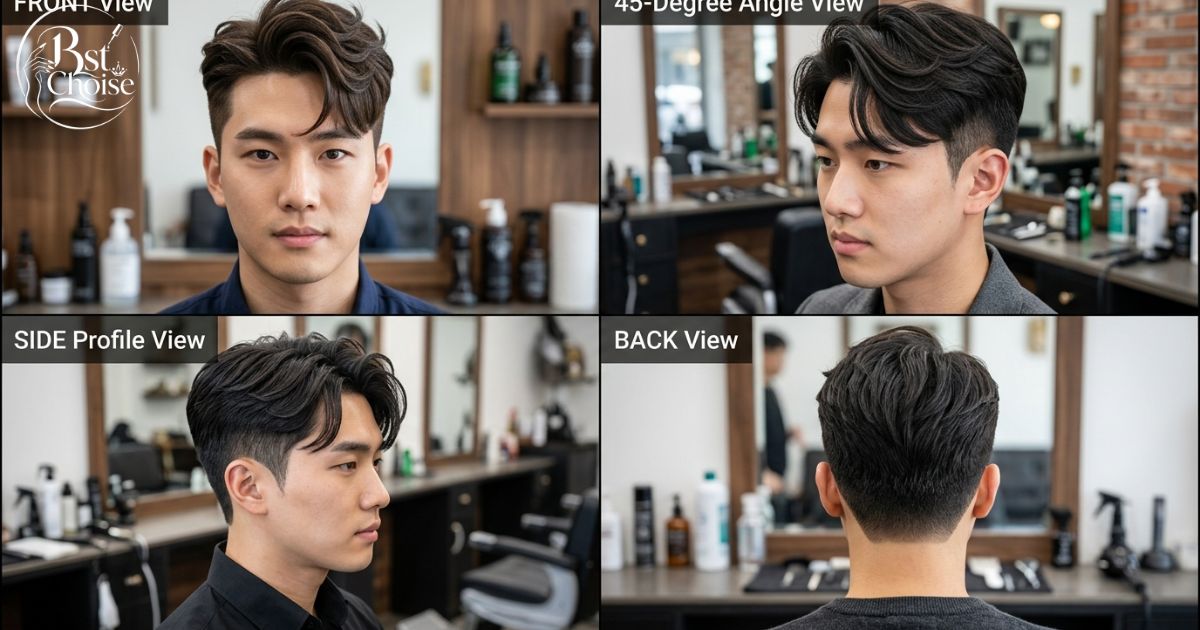

If you’ve scrolled through K-drama stills or K-pop fan cams and noticed that soft, curved fringe sweeping across a guy’s forehead, you’ve already met comma hair. It’s one of the few men’s hairstyles that manages to look effortless and deliberate at the same time, a single curved lock that reads like a punctuation mark and instantly updates almost any haircut underneath it.
What makes comma hair worth the hype isn’t just the shape itself. It’s how adaptable that shape is. The same curved fringe can sit on top of a two-block cut, a mid fade, a shaggy textured crop, or even longer flowing hair, and it will look like a completely different haircut every time. That flexibility is exactly why it has stuck around since its K-pop breakout and why barbers everywhere are still getting asked for it.
This guide walks through 20 comma hairstyle variations, how to choose one for your face shape and hair type, how to style and maintain it, the products that actually work, and the mistakes that quietly ruin the shape. By the end, you’ll know exactly what to ask your barber for, and why.
1. Classic Comma Haircut for Men
The original version is still the benchmark. The front section is left long enough to be blow-dried into a single, soft “C” that curves across the forehead, while the top, sides, and back stay simple and neatly shaped. Nothing else competes with the fringe for attention.
This is the safest entry point if you’ve never worn comma hair before. It’s forgiving, easy for most barbers to execute, and gives you a clear baseline before you experiment with fades, texture, or volume.
Best for: First-timers who want the true, recognizable comma shape.
Face shapes: Oval, square, diamond, heart.
Hair type: Straight to slightly wavy, medium density.
Maintenance: A trim every 4–6 weeks keeps the curve intact.
Pros
- Instantly recognizable comma silhouette
- Pairs with almost any outfit or setting
- Straightforward for most barbers to replicate
Cons
- Front length has to be babied, cut it too short and the curve disappears
- Needs reshaping with a dryer most mornings

2. Korean Comma Hair With Soft Volume
This is the version most people picture when they think “K-pop hair.” The fringe still curves, but the emphasis shifts to airy volume through the crown rather than a tightly sculpted bend. Blow-drying against the root before shaping the front is what gives it that lifted, weightless look.
Because the volume does most of the visual work, the sides can stay fairly natural or receive only a soft taper, the goal is softness everywhere, not sharp lines.
Best for: Guys chasing that idol-inspired, romantic-but-masculine look.
Face shapes: Oval, oblong, heart.
Hair type: Fine to medium, straight.
Maintenance: Every 4–6 weeks, plus regular blow-drying to hold shape.
Pros
- Youthful, on-trend finish
- Adds visible fullness to thinner hair
- Flatters most Korean and East Asian face structures
Cons
- Volume needs a blow-dryer and round brush to recreate daily
- Rain or humidity can deflate it fast

3. Textured Comma Haircut
Instead of a glassy, smooth fringe, this version leans into deliberate texture, the ends are point-cut or lightly thinned so the top has separation and grain. The comma curve is still there, just less polished and more lived-in.
It’s a strong pick if you like the shape of comma hair but not the “salon-fresh” look that comes with it. Texture also hides slight growing-out phases better than a clean-cut fringe.
Best for: Men who want comma hair without looking overly styled.
Face shapes: Oval, round, square.
Hair type: Thick or coarse hair that can hold texture well.
Maintenance: 4–6 weeks, with occasional touch-up texturizing.
Pros
- Low-fuss, casual finish
- Disguises regrowth between cuts
- Adds dimension to flat, dense hair
Cons
- Over-texturizing thick hair can make it look thinner than intended
- Needs a barber comfortable with point-cutting, not just scissor-over-comb

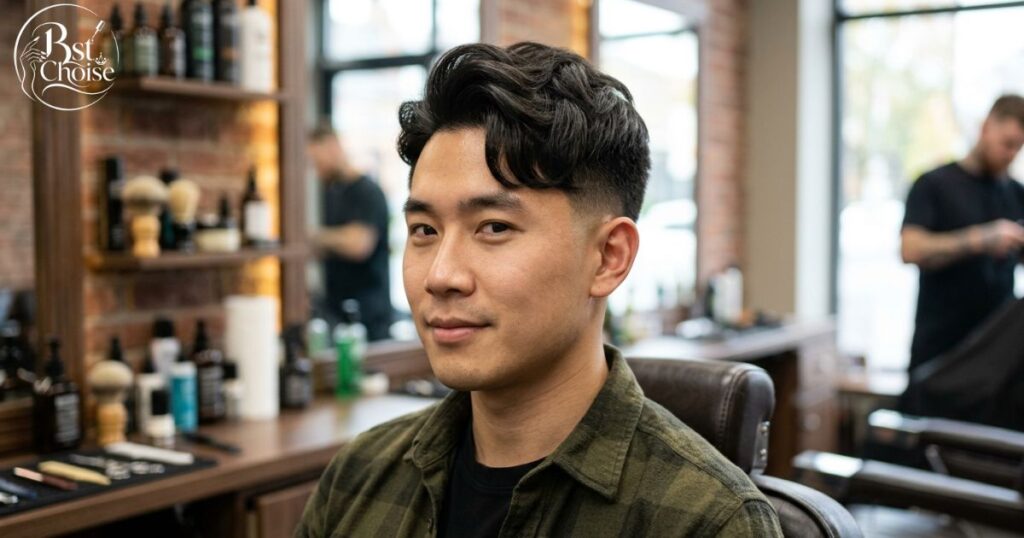
4. Comma Hair With a Low Taper
A low taper blends the hairline and around the ears without making a bold statement, it just cleans things up. The top stays full, so most of the visual interest remains at the front where the comma curve lives.
Think of this as the “office-safe” comma cut: modern enough to feel current, subtle enough to pass in a conservative workplace.
Best for: Men who want a contemporary cut that still reads professional.
Face shapes: Oval, round, diamond.
Hair type: Straight to wavy, medium-to-thick.
Maintenance: Taper needs a refresh every 3–4 weeks.
Pros
- Understated and workplace-friendly
- Sides stay fuller than a fade, which suits round or narrow faces
- Easier grow-out than a fade
Cons
- Less contrast means the fringe has to do more visual work
- Taper lines soften quickly and need upkeep
Read More: 20 Taper Fade Haircuts For Men That Look Sharp, Clean, & Modern
5. Short Comma Haircut
Here, overall length is trimmed down everywhere except the very front, where just enough hair is preserved to form a small, tight comma. It’s the lowest-maintenance version of the trend.
If you like the idea of comma hair but don’t want to deal with blow-drying or long-hair upkeep, this is the compromise: a hint of the shape without the commitment.
Best for: Guys who prefer short hair but still want a nod to the trend.
Face shapes: Oval, square, round.
Hair type: Straight, thick, low-porosity hair that holds shape.
Maintenance: Every 3–4 weeks, short hair grows out visibly fast.
Pros
- Quick to style, sometimes air-dry only
- Neat, tidy, and gym or travel friendly
- Less product needed overall
Cons
- The comma shape is subtler and easier to lose between cuts
- Not much room for restyling if you want a change

6. Comma Hair With a Mid Fade
A mid fade brings real contrast, the sides fade out around the temple, while the top stays long enough to be swept into the curved fringe. It’s a sharper, more “barbershop” version of the classic cut.
Because the fade draws the eye downward and outward, the fringe reads as more deliberate and structured than it does with a taper.
Best for: Men who want a defined, high-impact haircut.
Face shapes: Oval, square, diamond.
Hair type: Straight, wavy, or curly, fades work on most textures.
Maintenance: Every 2–3 weeks to keep the fade line crisp.
Pros
- Bold, magazine-ready contrast
- Makes the comma fringe the obvious focal point
- Works well for going out or formal occasions
Cons
- Fade grows out noticeably within two weeks
- Requires more frequent barber visits than a taper
7. Messy Comma Hairstyle
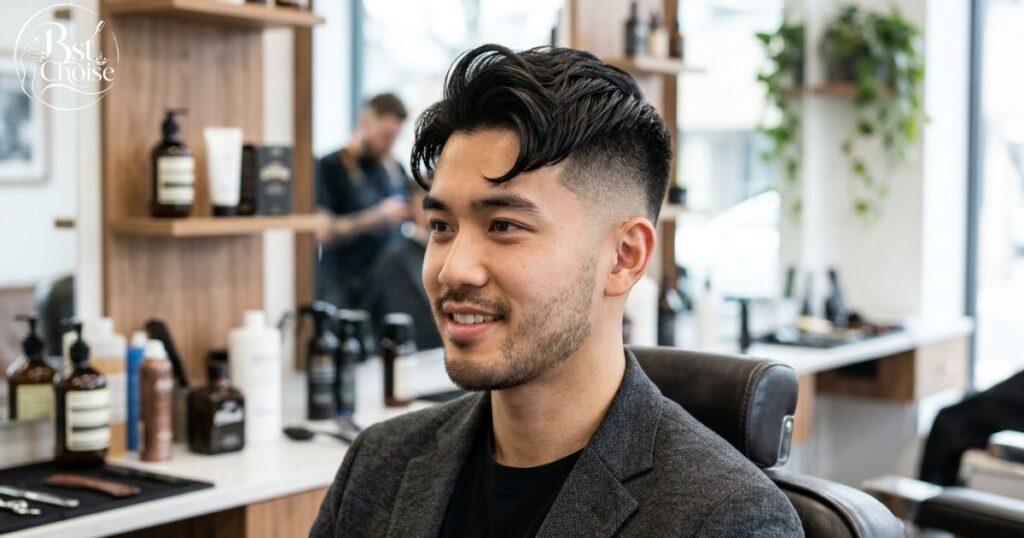
This take keeps the curved front but deliberately roughs up everything around it, fingers instead of a comb, texturizing spray instead of smoothing cream. The result looks unplanned even though the fringe shape is still intentional.
It works especially well on days when you don’t want to spend ten minutes with a blow-dryer but still want the comma silhouette to read clearly.
Best for: Everyday, low-effort styling.
Face shapes: Oval, heart, diamond.
Hair type: Wavy or straight with some natural texture.
Maintenance: Every 5–6 weeks; grows out gracefully.
Pros
- Fast to style, a few minutes with paste is enough
- Forgiving of humidity and regrowth
- Casual without looking unkempt
Cons
- Can tip into “unstyled” if you loosen the whole head, not just the crown
- Thick hair can look bulky if left too messy

8. Comma Fringe With Layered Top
Layering removes weight from the mid-lengths so the top moves rather than sits like a helmet. The front section is cut slightly longer than the surrounding layers to keep the fringe shape intact.
This is a smart option for men with medium-to-thick hair that tends to look heavy or flat when cut in one length.
Best for: Men who want movement and reduced bulk.
Face shapes: Oval, oblong, heart.
Hair type: Medium-to-thick, straight or wavy.
Maintenance: Every 5–7 weeks.
Pros
- Lighter, airier feel than a single-length cut
- Flatters hair that’s naturally dense
- Movement looks great with or without product
Cons
- Needs a barber skilled at layering, a rushed job flattens the fringe
- Layers can grow out unevenly

9. Two-Block Comma Haircut
Two-block hair, short, disconnected sides and back paired with a noticeably longer top, is the structural backbone most Korean-style comma cuts are built on. Add the curved fringe, and you get the full “idol haircut” look.
The disconnection between top and sides is what gives the fringe room to be styled dramatically without the rest of the head competing for attention.
Best for: Men chasing the full Korean-inspired aesthetic.
Face shapes: Oval, heart, oblong.
Hair type: Straight to slightly wavy, medium-to-thick.
Maintenance: Every 4–6 weeks.
Pros
- Maximum volume and styling flexibility on top
- Strong, recognizable silhouette
- Pairs naturally with the comma fringe’s curve
Cons
- The fuller top needs daily styling to avoid looking flat
- Not the easiest cut for a barber unfamiliar with Korean techniques

10. Side-Swept Comma Hair
This variation exaggerates the diagonal sweep of the fringe so it reads more like a deep side part with a hooked end than a centered curve. The rest of the top is styled in the same direction for a cohesive flow.
It’s a good option when you want comma hair to look a little more “grown-up” or formal without losing the signature bend.
Best for: Men who like directional, side-part-adjacent styling.
Face shapes: Oval, square, diamond.
Hair type: Straight to wavy, medium density.
Maintenance: Every 4–6 weeks.
Pros
- Reads slightly more polished than a centered comma
- Easy to dress up for interviews or events
- Strong side profile
Cons
- Fighting your natural growth pattern makes it collapse by midday
- Needs daily blow-dry and light hold product

11. Wavy Comma Hairstyle
Natural waves do a lot of the styling work here. Instead of forcing a razor-sharp curve, the wave pattern is allowed to soften the comma shape into something looser and more organic.
Barbers usually cut with the wave rather than against it, which means less blow-drying and more reliance on the hair’s own texture.
Best for: Guys with natural wave who want low-effort styling.
Face shapes: Oval, oblong, heart.
Hair type: Wavy, medium-to-thick.
Maintenance: Every 5–7 weeks.
Pros
- Works with your natural texture instead of against it
- Requires less daily styling than a straight comma fringe
- Adds visible depth and movement
Cons
- Humidity and rain can reshape the wave unpredictably
- Heavy product flattens the wave pattern quickly

12. Curly Comma Haircut
Curly comma hair leans fully into curl pattern rather than trying to disguise it. The front section is cut with shrinkage in mind, curls sit noticeably shorter dry than they measure wet, so the comma shape still reads once the hair springs up.
A tighter taper or fade around the sides gives the curls room to be the star of the show.
Best for: Men who want to work with, not against, their curls.
Face shapes: Oval, square, diamond, heart.
Hair type: Curly to coily.
Maintenance: Every 4–6 weeks.
Pros
- Unique texture that straight-haired comma cuts can’t replicate
- Great natural volume without much product
- Distinctive, hard-to-miss silhouette
Cons
- Needs a barber experienced with curl-specific cutting
- Shape can shift day to day depending on humidity and curl definition

13. Comma Hair With a Low Fade
A low fade sits closer to the hairline than a mid fade, so it reads as clean without stripping too much fullness from the sides. The longer top stays the focal point, with the fringe curving above the fade line.
It’s a middle ground for men who want fade-level sharpness but not the higher, more dramatic contrast of a mid or high fade.
Best for: Men who want tidy sides with a softer overall look.
Face shapes: Oval, round, square, diamond.
Hair type: Straight, wavy, thick, or curly.
Maintenance: Every 2–3 weeks.
Pros
- Cleaner than a taper, gentler than a mid fade
- Works across a wide range of hair textures
- Keeps visual weight up top where the fringe is
Cons
- Still needs regular touch-ups to avoid a grown-out, patchy line
- Slightly more upkeep than a taper

14. Voluminous Comma Hairstyle
This version is all about height. Roots are lifted with a blow-dryer before the front is shaped into its curve, giving the whole top a fuller, more sculpted presence, without adding bulk to the sides.
It’s particularly useful for men with fine hair, where added lift can make thin strands read as noticeably thicker.
Best for: Fine or flat hair that needs a boost.
Face shapes: Round, oval, diamond, heart.
Hair type: Fine to medium, straight.
Maintenance: Every 5–6 weeks.
Pros
- Creates the appearance of thicker, denser hair
- Adds height that balances a round or wide face
- Striking, editorial-looking silhouette
Cons
- Volume needs daily blow-drying to maintain
- Heavy pomade collapses the lift almost immediately

15. Long Comma Hairstyle With Flow
Longer hair gives the fringe room to curve gradually rather than sharply, and it can blend into hair that sweeps back or to the side at the crown. It’s a softer, more relaxed reading of the trend.
This is the version to try if you enjoy medium-length hair generally and want the comma shape woven into that, rather than built around a shorter, structured cut.
Best for: Men who already prefer medium-to-long hair.
Face shapes: Oval, diamond, oblong, heart.
Hair type: Straight to wavy, medium density.
Maintenance: Every 6–8 weeks.
Pros
- More versatility for restyling on any given day
- Flows naturally without looking forced
- Softer, less “cut in a mold” appearance
Cons
- Takes longer to blow-dry and style each time
- Needs more conditioning care to avoid looking limp

16. Clean Comma Haircut With Tapered Sides
Tapered sides fade gradually rather than sharply, keeping the sides tidy without the stark line a true fade creates. Paired with the comma fringe, it reads as neat and put-together rather than trend-forward.
This is a dependable option if you want a haircut that photographs well but doesn’t scream “I just got a fresh cut.”
Best for: A refined, everyday-appropriate look.
Face shapes: Oval, square, round, diamond.
Hair type: Straight to wavy, medium.
Maintenance: Every 4–5 weeks.
Pros
- Polished without being flashy
- Grows out more gracefully than a fade
- Works in most professional settings
Cons
- Less visual drama than a fade or undercut
- Neckline still needs regular cleanup between cuts
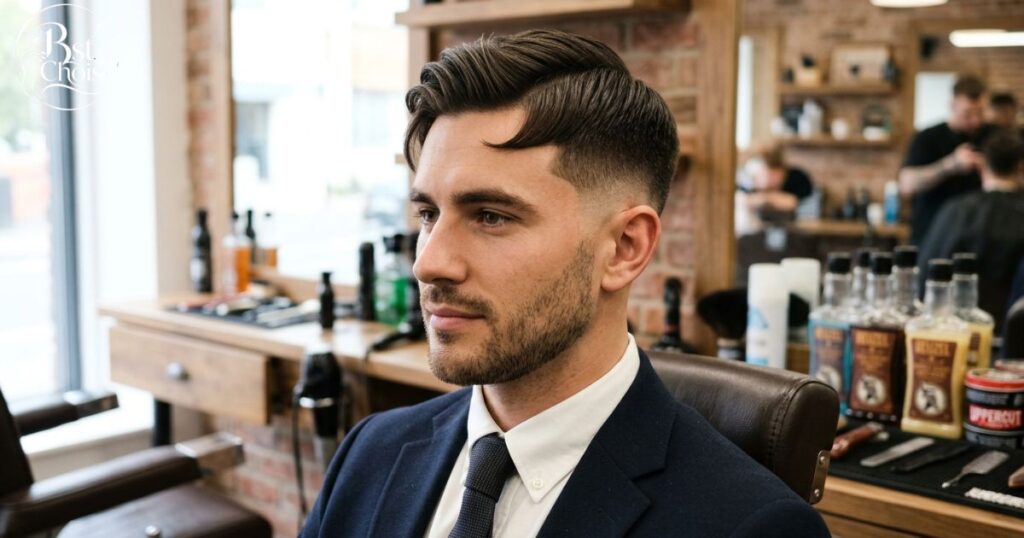
17. Comma Hair With Middle Part
Here, the front hair is divided at a natural middle part, and one side is styled into the signature comma curve while the other falls more like a curtain. It’s a hybrid that borrows from two of Korea’s biggest hair trends at once.
It only works if there’s enough length on both sides to fall and frame the face rather than stick straight up.
Best for: Fans of center-parted, face-framing styles.
Face shapes: Oval, heart, diamond, oblong.
Hair type: Straight to wavy, medium.
Maintenance: Every 5–7 weeks.
Pros
- Softens angular or strong features
- Blends curtain and comma trends in one cut
- Naturally face-framing
Cons
- Needs enough front length to hang correctly
- Can look flat without some added volume underneath

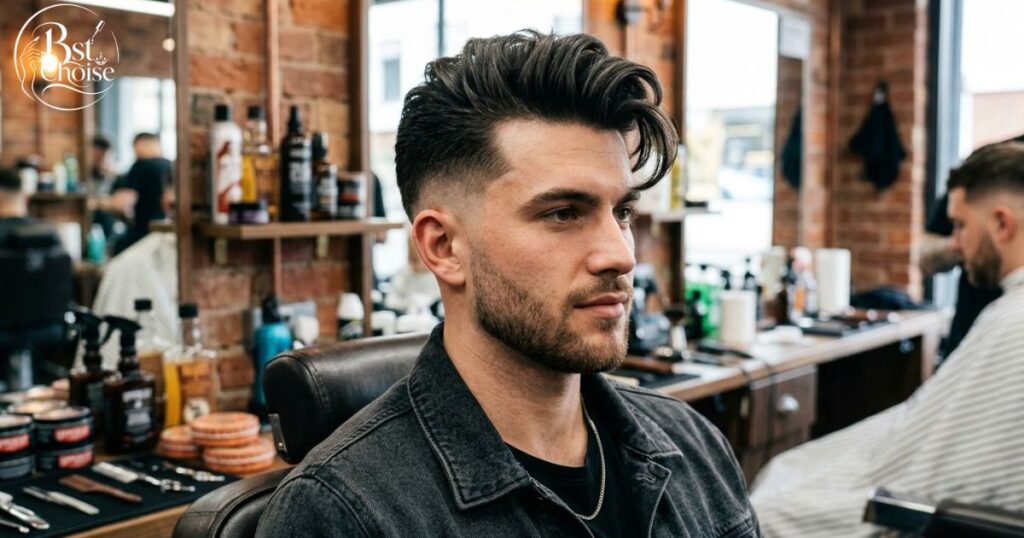
18. Comma Undercut Hairstyle
An undercut takes the contrast between top and sides further than a fade or taper ever could, the sides are shaved down close, leaving the longer top and its curved fringe as the undisputed focal point.
It’s a bold, high-commitment choice, best suited to men who are comfortable standing out.
Best for: A dramatic, statement-making cut.
Face shapes: Oval, square, diamond, round.
Hair type: Straight, thick, or wavy.
Maintenance: Every 2–4 weeks.
Pros
- Maximum contrast makes the fringe impossible to miss
- Feels current and fashion-forward
- Sides stay virtually maintenance-free between cuts
Cons
- Grow-out looks patchy fast, especially disconnected undercuts
- Not the most versatile, hard to tone down for formal settings
19. Soft Comma Haircut for Fine Hair
Fine hair doesn’t need to be avoided when it comes to comma styling, it just needs a different approach. Instead of thinning the top further, the cut preserves length and density at the front to create the illusion of fullness.
Lightweight, volumizing products do more here than heavy waxes, which tend to make already-fine strands look even sparser.
Best for: Men with fine or thin-looking hair.
Face shapes: Oval, diamond, heart, round.
Hair type: Fine, straight to slightly wavy.
Maintenance: Every 4–6 weeks.
Pros
- Builds the appearance of density without extensions or fibers
- Lightweight styling routine
- Soft, natural-looking finish
Cons
- Heavy pomades and creams will flatten it within hours
- Needs a barber who won’t over-thin the top out of habit

20. Modern Comma Hairstyle for Men
The modern comma cut isn’t one specific haircut, it’s the mindset of blending the curved fringe with whatever cutting technique suits your hair best: a fade, texture, layers, or a soft taper. There’s no single “correct” version.
The strongest results come from barbers who adjust the shape to your natural hairline and growth pattern instead of copying a reference photo exactly.
Best for: Anyone who wants an adaptable, current take on comma hair.
Face shapes: Most shapes, with proportions adjusted accordingly.
Hair type: Straight, wavy, curly, fine, or thick, all workable.
Maintenance: Every 4–6 weeks.
Pros
- Fully customizable to your hair and lifestyle
- Can flex from casual to polished
- Combines well with nearly any side treatment
Cons
- Requires ongoing fringe upkeep to look intentional
- Some variations demand daily styling time

How to Choose the Right Comma Hairstyle for Your Face Shape
The comma fringe pulls attention straight to the forehead and eyes, so small tweaks in length, direction, and volume can shift how a face shape reads.
| Face Shape | What to Ask For |
| Oval | Nearly any version works, you have the most freedom here. |
| Round | Extra height on top with cleaner, tighter sides to add length visually. |
| Square | A softer, textured curve rather than a razor-sharp one, to ease the jawline. |
| Diamond | Keep some fullness at the upper sides so the haircut doesn’t look too narrow. |
| Heart | A gentler fringe with moderate side volume to balance a wider forehead. |
| Oblong | Avoid extra height, a fuller fringe with side volume improves proportion. |
How to Style Comma Hair at Home
- Start on damp hair. Decide which direction the curve should fall, usually the direction your hair already wants to go.
- Blow-dry with direction. Use a round brush or your fingers to guide the front section as it dries, curving it inward.
- Add product sparingly. A small amount of cream, clay, or mousse, worked only through the top and fringe, not the whole head.
- Shape, don’t coat. Use your fingertips to define the curve rather than smoothing everything flat.
- Set and release. Once the shape holds, stop touching it. Overworking the fringe is the fastest way to flatten it.
Comma Hair Maintenance Guide
The fringe needs attention before anything else. A few extra millimeters of front length can change the whole shape, so barbers usually trim it more precisely than the rest of the cut.
A simple maintenance routine:
- Trim the fringe as soon as it starts falling into your eyes.
- Keep sides and neckline tidy between full haircuts.
- Reach for lightweight products over heavy waxes.
- Rinse with lukewarm, not hot, water to protect natural shine.
- Match your product to your hair texture rather than using one product for everything.
| Style Type | Typical Trim Schedule |
| Fade or undercut variations | Every 2–3 weeks |
| Taper variations | Every 3–5 weeks |
| Longer, flowing, or wavy variations | Every 6–8 weeks |
Best Styling Products for Comma Hair
Comma hair looks best when it can still move, stiff, overly set hair loses the soft curve that makes the style recognizable.
| Product | Best For | Finish |
| Styling cream | Everyday, natural movement | Soft, low shine |
| Matte clay | Textured or messy variations | Matte, no shine |
| Light pomade | Defined, directional fringes | Moderate shine |
| Volumizing mousse | Fine or flat hair | Lightweight lift |
| Texture powder | Fine hair needing grip | Dry, fuller look |
| Curl cream | Curly comma hair | Defined, frizz-free |
Apply less than you think you need. It’s far easier to add more product than to correct hair that’s already overloaded.
Comma Hair for Different Hair Types
- Straight hair: The most straightforward texture to work with, a blow-dryer and round brush create a clean curve with minimal effort.
- Wavy hair: Let the natural wave show through instead of forcing pin-straight styling; it softens the shape nicely.
- Curly hair: Cut with shrinkage in mind, and expect the shape to shift slightly depending on humidity and curl definition.
- Thick hair: Controlled layering removes excess bulk while keeping the fringe full enough to curve properly.
- Fine hair: Skip aggressive thinning; lean on volumizing products instead to build the appearance of density.
Comma Hair vs. Curtain Hair
Both styles rely on longer front sections, but the styling direction sets them apart.
Comma hair centers around one dominant curved fringe that sweeps and hooks to one side, creating that signature punctuation-mark shape.
Curtain hair, by contrast, splits the front into two symmetrical sections around a middle part, framing both sides of the face evenly.
If you want a single, eye-catching curved feature, comma hair is the stronger pick. If you prefer a balanced, face-framing look on both sides, curtains are usually the better fit.
Comma Hair With Glasses
Comma hair and glasses tend to get along well, since the curved fringe frames the upper face without necessarily covering the frames themselves.
- Larger frames: Keep the fringe lighter and slightly shorter so the eye area doesn’t feel crowded.
- Smaller or thin frames: You have more room to experiment with a fuller, higher-volume fringe.
- Barber tip: Bring your glasses to the appointment, they change how much fringe reads as balanced once you put them back on.
Who Should Try a Comma Hairstyle?
Comma hair suits you especially well if you:
- Like medium-length hair around the front and don’t mind spending a few minutes styling it
- Want an update on the standard fringe without going full pompadour or quiff
- Already have (or are willing to grow) enough front length for the curve
- Prefer movement over a rigid, sprayed-in-place look
- Want a cut flexible enough to pair with a fade, taper, or fuller sides later
If you’d rather keep hair extremely short with zero daily styling, a buzz cut or classic crop will suit your routine better than comma hair will.
Common Comma Hair Styling Mistakes
Making the Fringe Too Perfect
A flawless, symmetrical curve can end up looking artificial. A touch of natural imperfection usually reads as more authentic and current.
Using Too Much Product
Heavy wax or pomade weighs the fringe down and can leave it looking greasy instead of soft and defined.
Ignoring the Hairline
Your natural hairline shapes how the curve sits. Trying to force a reference photo’s exact shape onto a different hairline rarely translates well.
Cutting the Front Too Short
Length is what creates the curve in the first place. Cut it too aggressively and you may be waiting weeks for the shape to come back.
Over-Thinning Thick Hair
Removing too much density leaves the fringe limp. The goal is to manage weight, not strip it out entirely.
How to Tell Your Barber What You Want
Saying “give me comma hair” alone often leads to a result that isn’t quite what you pictured. Be specific about:
- How long you want the front to stay
- Which direction the fringe should curve
- Whether you want a taper, fade, or fuller sides
- How much volume you want through the crown
- Whether you’re after a polished or a more textured, natural finish
Bringing a front-view and side-view reference photo helps enormously, the same fringe shape can look completely different depending on the angle it’s photographed from.
Frequently Asked Questions About Comma Hair
What is a comma hairstyle for men?
It’s a haircut where the front hair is styled to curve across the forehead in a shape that resembles a comma, usually paired with shorter or tapered sides.
Is comma hair still popular?
Yes, its adaptability across tapers, fades, textures, and hair types keeps it relevant well beyond its initial K-pop-driven popularity.
How long does hair need to be for comma hair?
There’s no exact minimum, but the front generally needs several inches of length to curve and hold its shape once styled.
Can you get comma hair with straight hair?
Yes, straight hair is actually one of the easiest textures to shape into a clean, defined comma curve.
Can curly-haired men wear comma hair?
Yes, curls create a fuller, more textured version of the shape, as long as the cut accounts for how much the curls shrink once dry.
Does comma hair work with a fade?
Yes, a low or mid fade adds sharp contrast under the fringe, while a taper gives a softer, more gradual finish instead.
How do you make comma hair stay in place?
Blow-dry the fringe into shape first, then apply a small amount of lightweight product to hold the curve through the day.
Is comma hair good for fine hair?
It can be, especially when the cut preserves length for fullness and pairs with volumizing rather than heavy, flattening products.
How often should comma hair be trimmed?
Most versions need a trim every 4–6 weeks, though fades and shorter tapers usually need attention every 2–3 weeks.
Conclusion
Comma hair earns its staying power because it isn’t one rigid haircut, it’s a front-of-head detail that adapts to nearly any base style, from a sharp mid fade to a relaxed, wavy crop. Whether you want something office-appropriate, something bold enough for an undercut, or something as simple as a short, low-maintenance cut, there’s a version of this trend that fits your hair type and daily routine.
The formula that works across all twenty variations is the same: keep enough front length for the curve to exist, use a light hand with product, and let your barber tailor the shape to your actual hairline instead of a photo. Get those three things right, and comma hair will look as good on you as it does on the reference pictures that got you interested in the first place.

