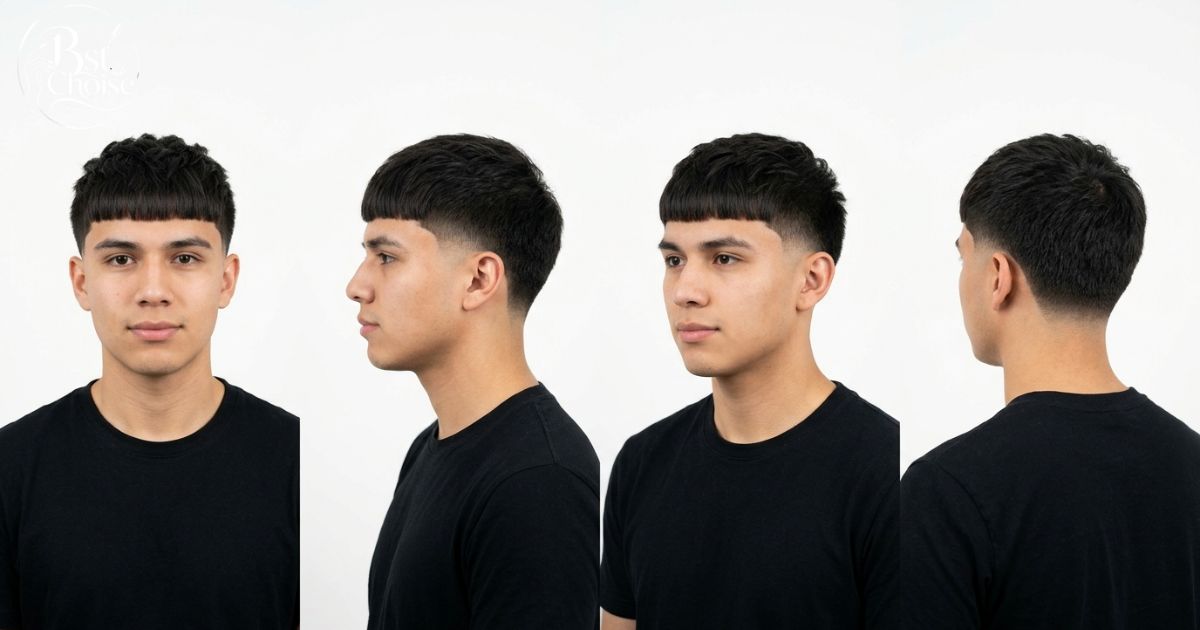

A mid taper fade Edgar cut pairs a short, blunt fringe with sides that fade out halfway up the head. The fringe gives you the bold front line. The taper keeps everything else clean. That mix is why barbers keep getting asked for it.
This guide covers eight styles, plus what to say in the chair, which guard numbers to ask for, and how to keep the line sharp between visits. It also shows which version fits your hair type, face shape, and age.
Quick answer: To get a mid taper fade Edgar cut, ask for a short, straight, blunt fringe cut across the forehead, with a mid taper (guard 1 or 2 blending to skin) on the sides and back. Trim the fringe every 2 to 3 weeks.
Mid Taper Fade Edgar Cut Explained: What Makes It Different
The Edgar cut, also called the takuache cut, is a short cropped top with a flat, blunt fringe and faded sides. It became popular among young Latino men and has since spread worldwide.
The “mid taper fade” part describes the sides. A mid taper starts to shorten around the midpoint between your temple and your ear. It then blends smoothly into the neckline. It is less dramatic than a high fade and cleaner than a low taper.
Here is what sets the cut apart:
- The fringe is straight. It is cut flat across the forehead, not swept or feathered.
- The line is the focus. The whole haircut is built around one clean edge at the front.
- The taper balances it. A sharp fringe can look heavy. A mid taper lightens the sides so the top stands out.
- The top stays short. Most versions sit between a half inch and about two inches, depending on texture.
Many people mix up the Edgar with a French crop or a regular fringe. We compare them in detail further down.
8 Best Mid Taper Fade Edgar Cut Styles
These eight styles all use the same base: a mid taper and a blunt fringe. What changes is texture, detail, and length. Use the table to compare them fast.
| Style | Best For | Maintenance | Look |
| Classic Mid Taper Edgar | Straight to wavy hair | Medium | Sharp, clean |
| Edgar with Straight Hair | Fine to medium straight hair | Medium | Crisp, geometric |
| Wavy Edgar | Wavy hair | Medium | Soft but defined |
| Textured Edgar | Medium to thick hair | Medium | Choppy, modern |
| Curly Edgar | Curly and coily hair | Medium to high | Full, rounded |
| Edgar with Design | Any texture | High | Bold, personal |
| Edgar with Beard Connect | Guys with full facial hair | High | Mature, structured |
| Short Fringe Edgar | Busy schedules | Low to medium | Neat, minimal |
Classic Cuts: The Signature Line
These two versions stay closest to the original. They are the best starting point if you have never had an Edgar cut.
1. Classic Mid Taper Edgar Cut
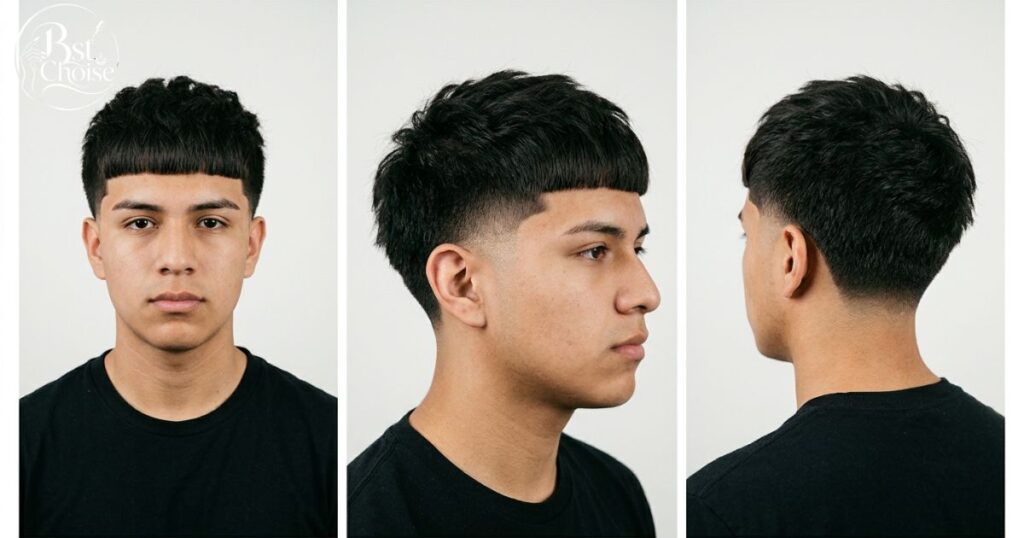
This is the version most people picture. The fringe sits low and flat across the forehead. The sides taper at mid height with a soft blend into the skin.
- Fringe length: About 1 to 1.5 inches
- Sides: Guard 2 fading to guard 1 or skin
- Best for: Straight or slightly wavy hair with medium density
- Styling: A pea-sized amount of matte paste, pushed forward
If you only try one style from this list, make it this one. It shows off the whole point of the haircut.
2. Edgar Cut with Straight Hair
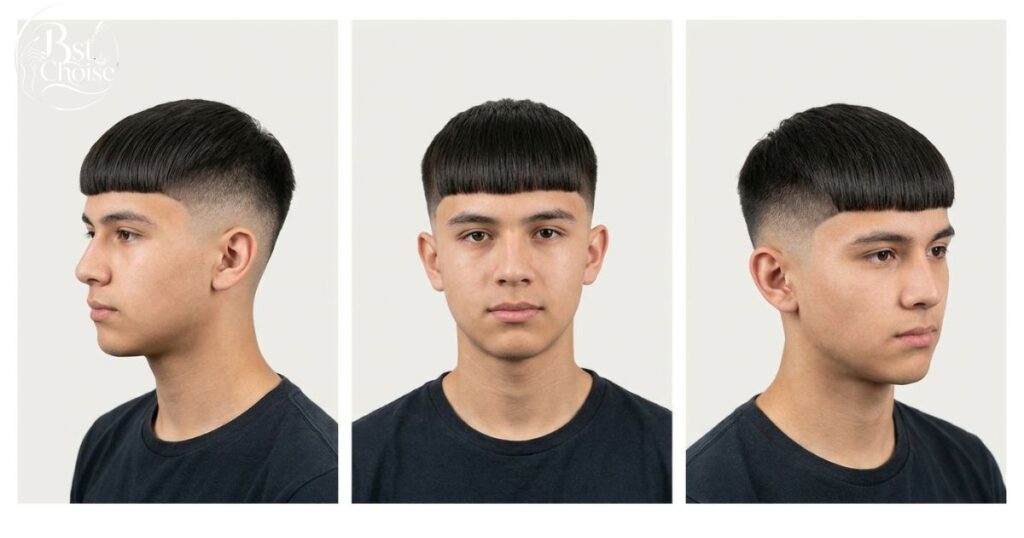
Straight hair gives the sharpest result. There is no natural bend to break up the line, so the fringe falls like a ruler edge.
- Fringe length: Just above the eyebrows
- Sides: Mid taper with a clean edge-up at the temples
- Best for: Fine to medium straight hair, including thick Asian hair
- Styling: Blow-dry forward, then add light clay for hold
The trade-off: any uneven cut shows. Pick a barber who does precise clipper and scissor work.
Textured and Wavy Variations
Texture softens the sharp front line. You still get the Edgar shape, but with more movement and a less severe finish.
3. Wavy Edgar Cut
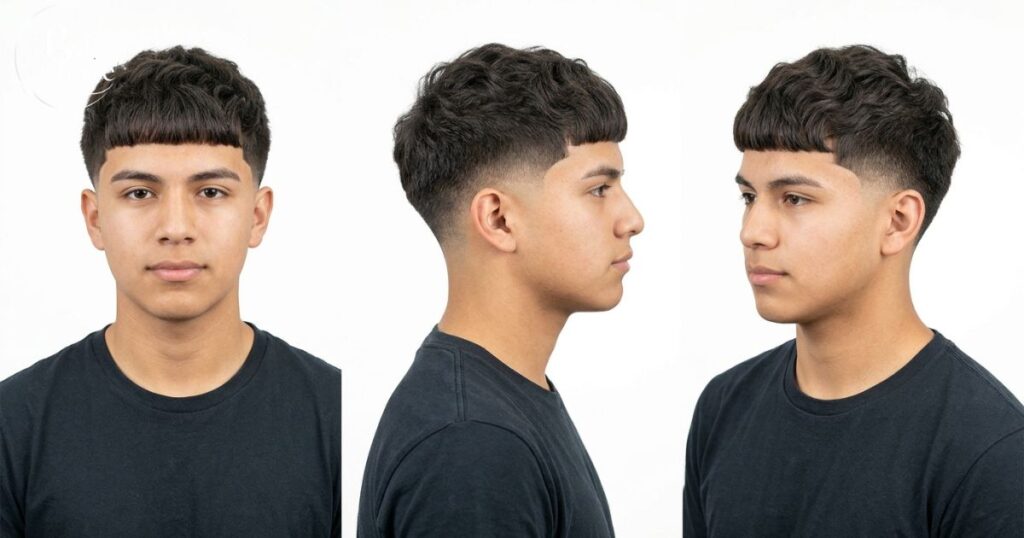
Waves add body to the fringe. Instead of a razor-flat edge, you get a slightly broken line that looks relaxed but intentional.
- Fringe length: Slightly longer than the straight version, since waves lift up
- Sides: Mid taper, kept a little fuller near the top of the blend
- Styling: Sea salt spray on damp hair, then air dry or diffuse
Barber tip: Ask for the fringe to be checked dry. Wavy hair can jump up a half inch once it dries.
4. Textured Edgar Cut
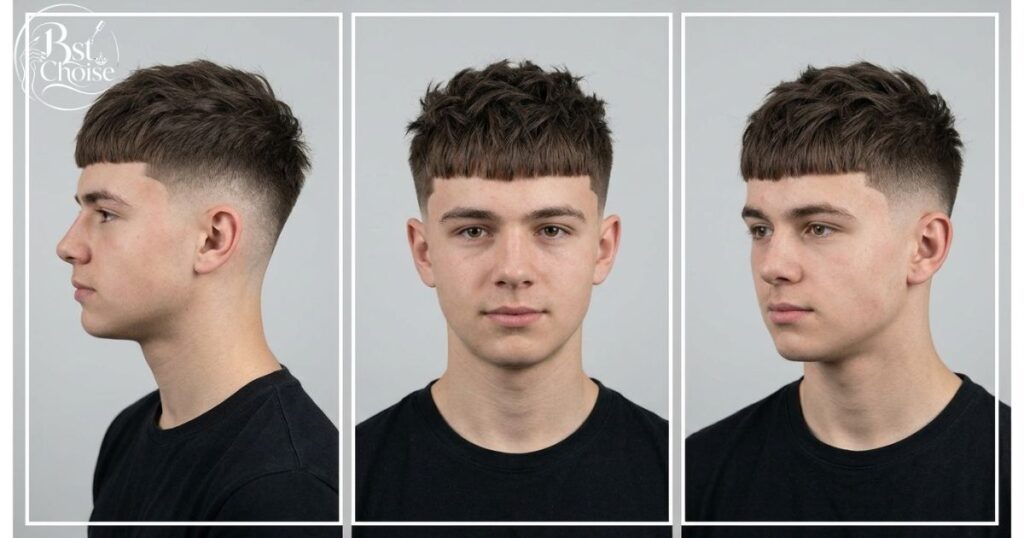
This one uses point cutting or razor work on top to create choppy, layered movement. The front still sits flat, but the crown looks fuller.
- Fringe length: About 1.5 to 2 inches
- Sides: Mid taper with a sharp line-up
- Best for: Medium to thick hair that tends to sit flat
- Styling: Texture clay, worked through with your fingertips
It is a good pick if the classic cut feels too plain.
Read More: 17 Best Mid Taper Fade Curly Hair Styles (2026)
5. Curly Edgar Cut
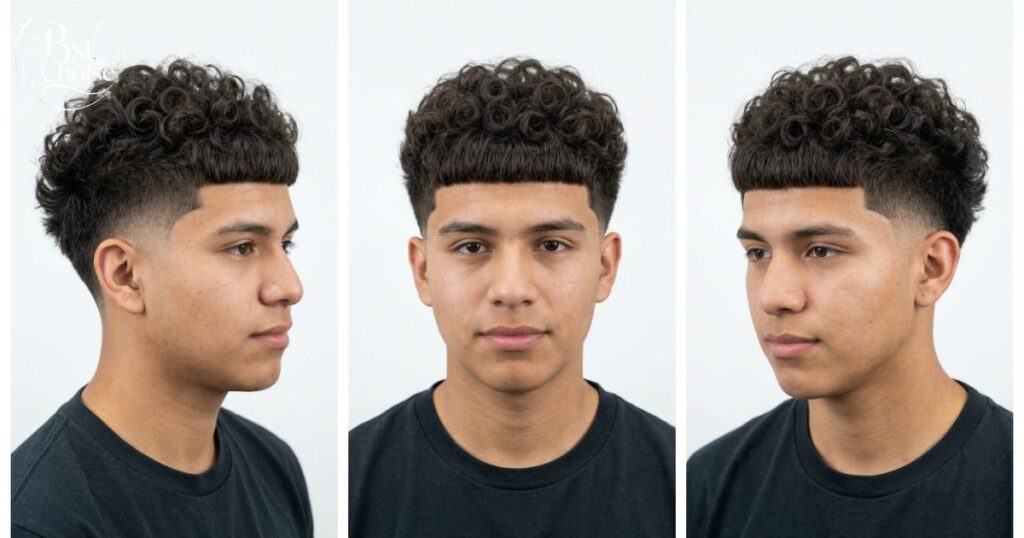
Curls change the cut in a good way. The fringe becomes soft and rounded, and the top gains volume. The mid taper keeps the sides tidy so the curls get the attention.
- Fringe length: Cut longer than you want it to end up, because curls spring back
- Sides: Mid taper or mid skin taper
- Styling: Leave-in conditioner or curl cream, then diffuse or air dry
You will get an “Edgar-inspired” look rather than a perfectly flat line. For most guys with curls, that is the better outcome.
Detail Work
These versions add something extra. They look great, but they need more regular upkeep.
6. Edgar Cut with Design
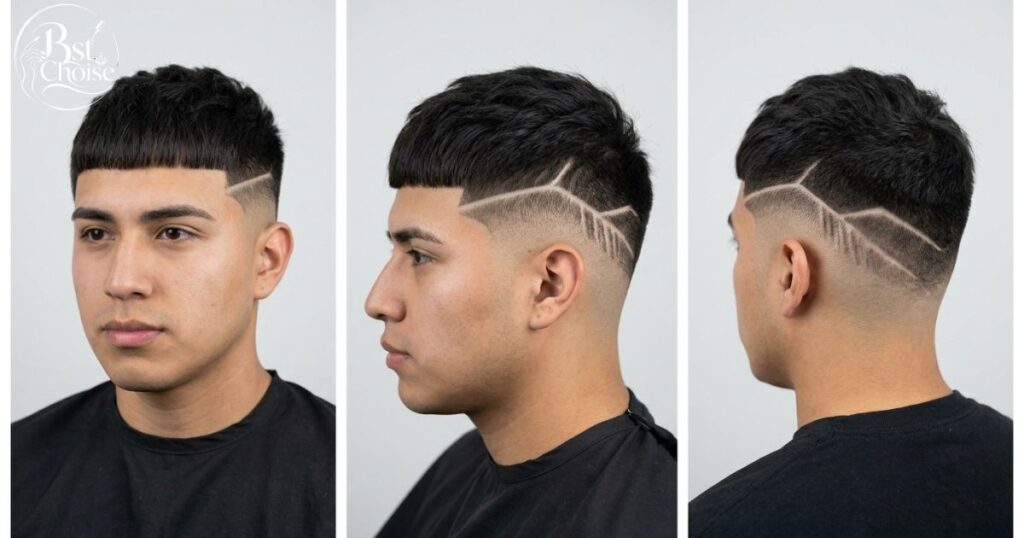
A shaved line, part, or small pattern is cut into the tapered area. Common spots are above the ear, along the temple, or at the nape.
- Best for: Any hair type, as long as the sides are short enough to show the work
- Cost: Designs usually add a few dollars to the haircut price
- Upkeep: Fresh lines blur in about a week or two
Start with a single hard line. Move to complex patterns once you trust your barber.
7. Edgar Cut with Beard Connect
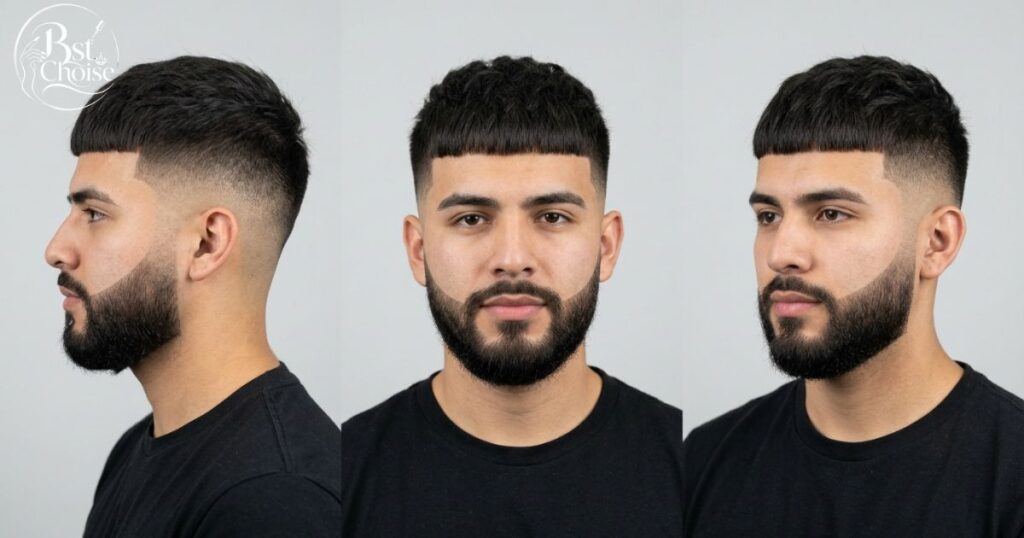
Here the taper flows straight into your beard. The sideburn, jawline, and fringe all read as one connected shape.
- Best for: Medium to full beards, square or oval faces
- Sides: Mid taper blending into a shaped beard line
- Upkeep: Neck and cheek lines need cleaning often
This version looks older and more polished than the clean-shaven cut.
Low-Maintenance Version
8. Short Fringe Edgar Cut
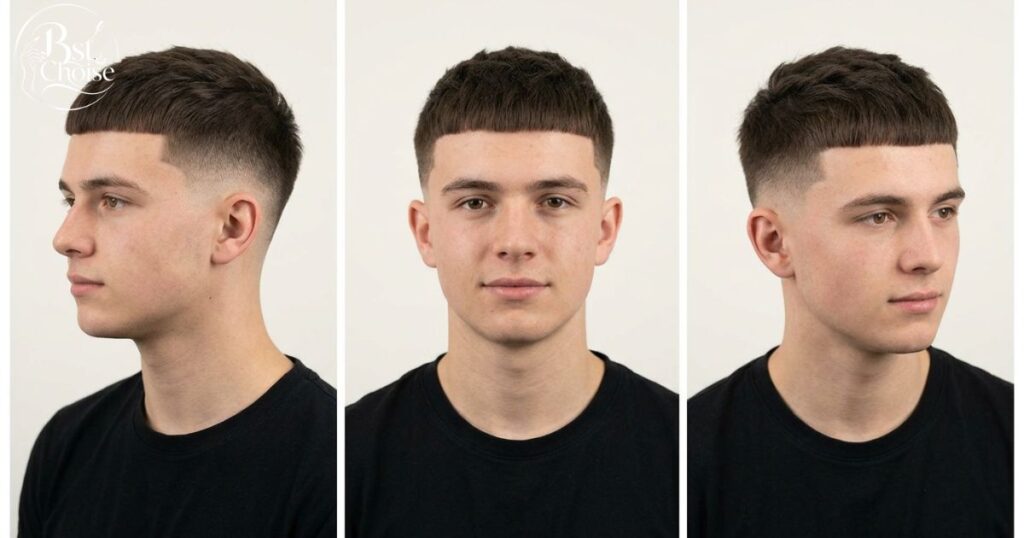
If you want the look without the constant visits, go shorter. A short fringe stays neat for longer and grows out without turning shaggy.
- Fringe length: Roughly half an inch to 1 inch
- Sides: Mid taper, guard 1 or 2
- Best for: Students, office workers, and anyone who dislikes daily styling
- Styling: Often none, or a dab of paste
Why the Edgar Cut Took Over in 2026
The Edgar cut did not disappear after its first wave. It settled into regular rotation at barbershops for a few clear reasons:
- It looks styled without much effort. The shape does the work for you.
- It suits many hair types. Straight, wavy, and curly hair can all wear a version.
- Short-top, clean-side cuts are still in demand. Fades and tapers remain core barbershop requests.
- Social media keeps feeding it. Short videos of fringe cuts and taper blends make the style easy to copy.
- It is easy to customize. Add a design, a beard connect, or texture and it becomes your own.
The mid taper also helps. It feels more grown-up than a high skin fade, so the cut works in more settings.
Pros and Cons: What You’re Signing Up For
No haircut is perfect. Here is the honest picture.
| Pros | Cons |
| Sharp look with little daily styling | Uneven lines are very easy to spot |
| Mid taper suits most settings | Needs fringe trims every 2 to 3 weeks |
| Works on straight, wavy, and curly hair | Curly hair softens the crisp edge |
| Easy to personalize | Needs a barber who is skilled at straight lines |
| Hides thinning on the sides better than long cuts | Low fringe can feel too bold at first |
Choosing by Hair Type: Where the Fringe Line Holds Best
Hair texture decides how crisp your fringe will look. Pick your version based on how your hair behaves, not just on a photo.
Straight Hair
Straight hair is the easiest to cut and hold. The fringe stays flat and the edge looks clean. Fine straight hair may need a little texture powder to stop it from looking limp. Thick straight hair may need thinning so the fringe does not stick out.
Wavy Hair
Wavy hair gives a softer line with more body. Keep the fringe a bit longer than you think you need. Waves tend to lift as they dry. Use a light cream or sea salt spray to define the pattern.
Curly Hair
Curly hair gives you volume and a rounded fringe. Ask your barber to cut it dry, curl by curl, so the shape matches how it really falls. Moisture matters here. Dry curls frizz and make the fringe look uneven.
Face Shape Matchups
A low, straight fringe changes how your face looks. Use this table as a starting point.
| Face Shape | Best Version | What to Watch |
| Oval | Almost any style | Few limits |
| Round | Textured Edgar with a slightly higher fringe | Avoid a very heavy, low fringe |
| Square | Classic or beard connect | Sharp lines suit a strong jaw |
| Heart | Short fringe Edgar | Skip heavy weight at the forehead |
| Long | Classic, low fringe | A low fringe shortens the face |
| Diamond | Textured or wavy Edgar | Soft texture balances cheekbones |
| Rectangular | Moderate-length wavy or textured | Avoid a very high, short fringe |
Oval Face
Oval faces are balanced, so you can wear nearly any version. The classic cut is a safe, flattering choice.
Round Face
Round faces look best with a bit of height and texture. Keep the fringe slightly shorter and let the mid taper add contrast on the sides.
Square Face
The strong jaw matches the geometric fringe. Adding a beard connect makes the structure even stronger.
Heart-Shaped Face
Heart-shaped faces are wider at the forehead. A short, light fringe avoids adding more weight to that area.
Long Face
A lower fringe helps shorten the look of a long face. The classic version is usually the best fit.
Diamond Face
Diamond faces have wide cheekbones. A little texture on top softens them and stops the cut from looking too harsh.
Rectangular Face
Choose a medium-length fringe with some movement. Extremely short fringes can make a long face look longer.
Age Group Breakdown
The cut is flexible. What changes with age is how bold you go.
Teenagers
Teens often pick the classic or textured version. It is easy to manage before school and looks neat without much product. If your school has a dress code, check it before asking for a design.
Young Men
Your twenties are a good time to experiment. Try a design, a beard connect, or a bolder fringe. If you do not like it, hair grows back.
Professional Men
In a work setting, the short fringe or classic version looks best. Keep the taper conservative and skip loud designs. Matte products read cleaner than shiny ones.
Talking to Your Barber: The Exact Guard Numbers
Words like “Edgar” mean different things to different barbers. Be specific, and bring a photo. Clipper guard numbers are a simple way to describe length.
| Guard | Length | Typical Use in This Cut |
| 0 / bare | Skin-level | Bottom of the taper, neckline |
| 1 | 3 mm | Lower blend zone |
| 2 | 6 mm | Mid blend zone |
| 3 | 10 mm | Upper blend zone or longer sides |
| 4 | 13 mm | Top of the taper if you want more length |
Note that exact guard sizes vary slightly between clipper brands. Your barber may also use a lever setting instead of guards, so describe the look as well as the number.
What to say:
- “I’d like a mid taper, starting around the middle of the temple and fading down to skin at the neckline.”
- “Keep the top short with a straight, blunt fringe, about [your length] above the eyebrows.”
- “Please cut the fringe dry so I can see the final length.”
- “Clean up the temples with a line-up, but keep it natural.”
- Show a reference photo that matches your hair type.
Video Guide: Watch the Fringe Get Cut
It is much easier to understand this haircut when you see it done. Search for a mid taper Edgar tutorial on YouTube and look for these steps:
- How the barber sections the top and sets the fringe guide line
- How the taper is blended with clippers and scissor-over-comb
- How the final edge is detailed with trimmers
- Whether the fringe is checked dry before finishing
Show your barber a video clip you like. It removes guesswork.
Common Mistakes That Ruin an Edgar Cut
Most bad Edgar cuts come from a few avoidable errors.
- Cutting wavy or curly hair wet. Hair shrinks as it dries, so the fringe ends up shorter than planned.
- Choosing the wrong barber. Straight lines take practice. Check their past work first.
- Using a photo that does not match your hair. Straight-hair photos will not look the same on curls.
- Going too short on the first try. A short fringe cannot be undone. Start a bit longer.
- Ignoring the taper. A sharp fringe on messy sides looks unfinished.
- Using too much product. Heavy gel makes the fringe look flat and greasy.
- Waiting too long between trims. Once the fringe grows past the eyebrows, the shape is lost.
Maintenance Reality Check
The cut is easy to wear but needs steady upkeep. Plan for it.
Fringe Trim Frequency
Trim the fringe every 2 to 3 weeks. Many guys book a quick fringe cleanup between full haircuts. The taper usually needs a refresh every 3 to 4 weeks.
Daily Styling
Styling takes about two minutes.
- Towel dry or blow-dry the hair forward.
- Warm a small amount of matte paste or clay in your palms.
- Push the fringe forward and flatten it with your fingers.
- Add a touch of texture spray if you want extra grip.
Washing Routine
Wash as often as your scalp needs. Oily scalps may need a wash daily or every other day. Dry scalps can go longer. Use a gentle shampoo and a light conditioner on the top to keep the fringe soft and easy to style. For general guidance, see the American Academy of Dermatology’s advice on shampoo frequency.
Mid Taper Edgar Cut vs Other Styles
The Edgar shares features with other short, fringe-heavy cuts. Here is how they differ.
| Feature | Edgar Cut | French Crop | Standard Fringe |
| Front line | Straight, blunt | Soft, textured | Swept, side, or layered |
| Top length | Short | Short to medium | Short to long |
| Cutting style | Precise, geometric | Mostly scissors | Varies |
| Look | Bold, structured | Relaxed, natural | Flexible |
| Upkeep | Fringe trims every 2-3 weeks | Every 4-6 weeks | Varies |
Edgar Cut vs French Crop
The French crop has a short, textured top and a shorter fringe that is cut with softer edges. The Edgar uses a straight blunt line. Choose the Edgar for a sharp look and the French crop for something more relaxed.
Edgar Cut vs Standard Fringe
A standard fringe can be styled in many directions. An Edgar fringe is always straight and low. If you like the idea of flexibility, a regular fringe may suit you better.
Frequently Asked Questions
What is a mid taper fade Edgar cut?
It is a haircut with a straight, blunt fringe on a short top and a mid-height taper on the sides and back.
What guard number should I ask for on a mid taper Edgar?
Most barbers use a guard 1 or 2 on the sides, blending to skin near the neckline. Always show a photo to confirm.
How often should I trim the fringe?
Every 2 to 3 weeks keeps the line sharp. Waiting longer makes the shape look overgrown.
Does an Edgar cut work on curly hair?
Yes. Curls make the fringe rounder and fuller, giving an Edgar-inspired look rather than a razor-flat edge.
Should the fringe be cut wet or dry?
Dry is safer for wavy or curly hair because wet hair shrinks as it dries.
What is the difference between an Edgar cut and a French crop?
The Edgar has a straight, blunt fringe, while the French crop has a softer, textured one.
Can I add a design to an Edgar cut?
Yes. A shaved line or pattern in the tapered area works well and does not change the fringe.
Is the Edgar cut good for thin hair?
Yes, if the hair is cut slightly longer on top and styled with light texture powder to add body.
What products work best for an Edgar cut?
Matte paste, texture clay, and sea salt spray are the usual choices. Avoid heavy gel.
Conclusion
The mid taper fade Edgar cut is simple to wear and sharp to look at. The straight fringe gives it character. The mid taper keeps it clean and balanced.
Start by choosing your version: classic, textured, curly, or short. Match it to your hair type and face shape. Then use the guard numbers and barber script above to ask for exactly what you want.
Book regular trims, keep styling light, and your Edgar cut will stay sharp. Save this guide for your next barber visit, and bring a photo that matches your hair texture.

