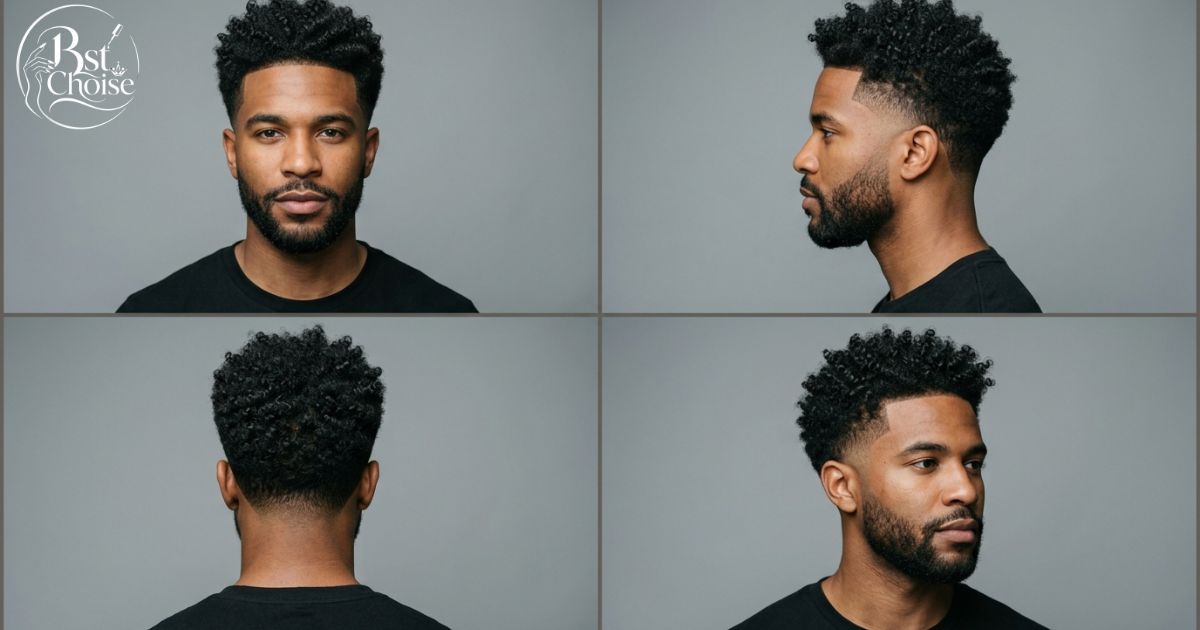

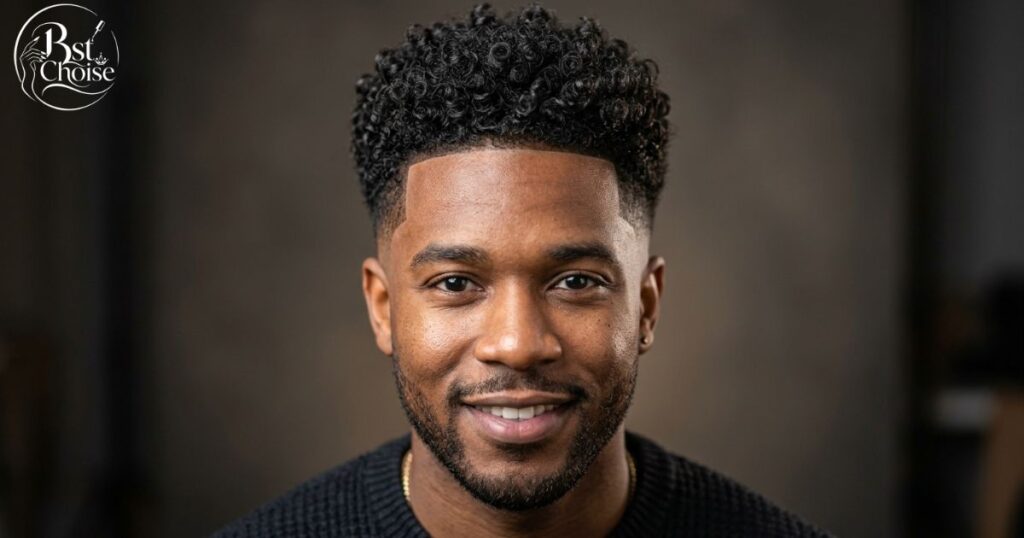
Low taper fade curly hair doesn’t behave like straight hair once it hits the clippers. It shrinks as it dries, it grows in different directions across the scalp, and it holds volume in a way that can make a badly placed fade look disconnected within a week. A low taper fade solves most of these problems because it works with the curl instead of fighting it, cleaning up the perimeter while leaving the natural pattern on top to do the talking.
Below are 20 low taper fade curly hairstyles that take different approaches to the same idea: keep the blend low, protect the density above the ears, and shape the top around how the curls actually sit. Whether you’ve got loose waves, springy 3B curls, or tight coils, there’s a version here built around your texture rather than someone else’s.
What Makes a Curly Low Taper Different?
A taper fade and a curly taper fade are not styled the same way, even though the clipper technique looks similar on paper.
With straight hair, a barber can fade the sides and know almost exactly how the top will fall once it’s dry. With curly hair, the same length can look completely different depending on curl pattern, porosity, and how much the strands contract after washing.
A low taper keeps the fading action close to the temples, sideburns, and neckline, rather than pushing the blend up toward the crown. This matters even more with curls because:
- Curly hair has more visual volume than straight hair at the same length, so a taper that climbs too high can make the top look like it’s floating above the sides.
- Curls shrink after drying, which means a haircut that looked balanced wet can look shorter and fuller once it airs out.
- Density isn’t uniform, the crown, temples, and nape often grow at different angles and thicknesses.
| Feature | Standard Low Taper | Low Taper on Curly Hair |
| Blend zone | Temple to neckline | Temple to neckline, kept slightly wider |
| Top texture impact | Minimal | Curl shape drives the entire silhouette |
| Risk area | Neckline blending | Upper-side density and crown balance |
| Styling need | Optional | Usually needed for curl definition |
| Regrowth pattern | Gradual, even | Uneven due to shrinkage and curl coil |
Pro tip: When you sit in the chair, don’t just say “low taper.” Tell your barber you want the upper-side curl density kept intact, that single instruction prevents most of the disconnected-looking cuts you see online.
1. Natural Curl Low Taper
This is the baseline cut every other style on this list borrows from. The curls on top are left completely untouched in terms of direction, no forced part, no combed-over fringe, while the taper only cleans the temple and neckline.
Best for: Guys who want their curl pattern to be the star of the haircut.
Hair type: Medium to tight curls.
Face shapes: Oval, square, diamond, round.
Maintenance: Every 2–3 weeks.
It’s the most forgiving option on this list because it doesn’t rely on precise shaping, the curl itself provides the texture and shape.
Pros: Low styling effort, keeps texture authentic, easy for a barber to replicate.
Cons: Result depends heavily on how consistent your curl pattern is; humidity can change the finish day to day.

2. Curly Fringe With Low Taper
The curls are left long enough on top to fall forward and frame the forehead, while the sides stay clean and low. This is one of the most popular curly cuts because the fringe does most of the visual work.
Best for: Men who want a defined front without a lot of daily effort.
Hair type: Medium to tight curls.
Face shapes: Oval, oblong, diamond.
Maintenance: Every 2–3 weeks.
Because curls shrink significantly once dry, a barber should always shape the fringe based on the dry length, not the wet one, otherwise it ends up shorter than expected.
Pros: Strong facial framing, makes curl texture more visible, works without a high fade.
Cons: Shrinkage can make the front unpredictable; needs regular trims to keep the shape.
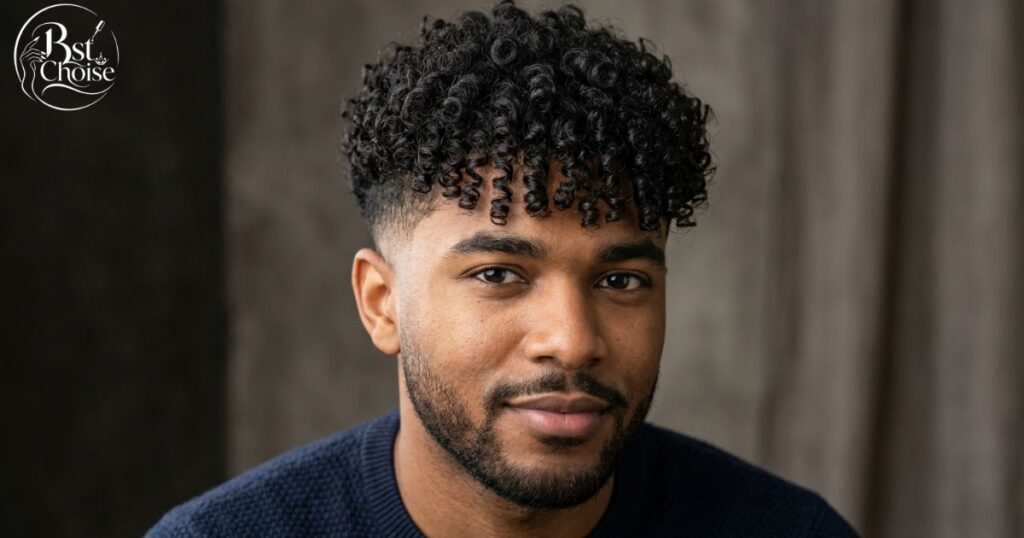
3. Curly Crop With Temple Taper
A shorter, tighter curl on top paired with a clean taper at the temples. It reads compact and structured rather than loose or flowing.
Best for: Guys who want short curls that still look deliberate, not buzzed.
Hair type: Tight or coarse curls.
Face shapes: Oval, square, diamond.
Maintenance: Every 2 weeks.
The top needs to keep just enough length for the curls to cluster together, cut it too short and the texture starts to look fuzzy instead of defined.
Pros: Minimal daily upkeep, holds shape well, suits dense curl types.
Cons: Needs frequent trims to stay sharp; not much room for restyling between cuts.

Read More: Modern Mullet: 55+ Haircuts For Men To Try In 2026
4. Curly Top With Beard-Connected Taper
The taper runs down through the sideburn and blends straight into the beard, creating one continuous line from scalp to jaw.
Best for: Men with medium-to-full beards who want a unified look.
Hair type: Curly, coarse, dense.
Face shapes: Square, oval, round.
Maintenance: Every 1–2 weeks.
The connection point at the sideburn is the part that makes or breaks this cut, it needs to blend, not jump abruptly from hair density to beard density.
Pros: Sharp side profile, grooming feels cohesive, pairs especially well with thicker curls.
Cons: Requires consistent beard upkeep; doesn’t translate well to patchy facial hair.
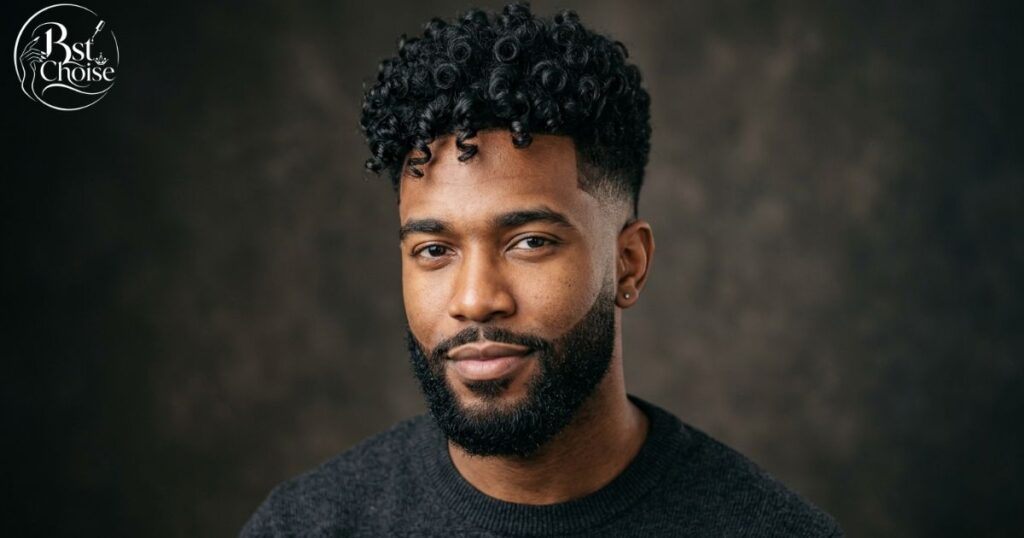
5. Loose Curly Flow With Low Taper
Rather than compressing the curls into a tight shape, this version lets the top grow outward so the curls develop natural movement and length.
Best for: Men who prefer their curls longer and looser.
Hair type: Loose curls, strong waves.
Face shapes: Oval, oblong, diamond.
Maintenance: Every 3–4 weeks.
Keep the taper conservative here, if the sides get taken too high, the longer top can start to look separated from the rest of the haircut.
Pros: Natural-looking movement, flexible styling, ideal while growing curls out.
Cons: Needs more curl-specific maintenance; can bulk up around the ears between cuts.

6. Short Coiled Taper
Tight coils are kept compact on top while the perimeter receives a precise, low taper.
Best for: Men with tightly coiled 4A–4C texture.
Hair type: Tight coils.
Face shapes: Oval, square, diamond.
Maintenance: Every 1–2 weeks.
Coily hair shrinks more than any other curl type, so the top should be judged by how it sits day-to-day, not by its stretched length right after the cut.
Pros: Clean, sharp perimeter, low daily maintenance, texture stays prominent.
Cons: Edges need touch-ups often; shrinkage can make length hard to predict.

7. Curly Caesar With Low Taper
Short curls are directed forward into a compact fringe, and the taper cleans up the lower sides for a low-effort, put-together look.
Best for: Guys who want a wash-and-go routine.
Hair type: Short, dense curls.
Face shapes: Oval, square, round.
Maintenance: Every 2 weeks.
Enough length needs to stay at the front for the fringe to actually read as a fringe, otherwise it just blends into the rest of the crop.
Pros: Almost no styling required, clean silhouette, works well on dense curls.
Cons: Grows out quickly; not very versatile between appointments.
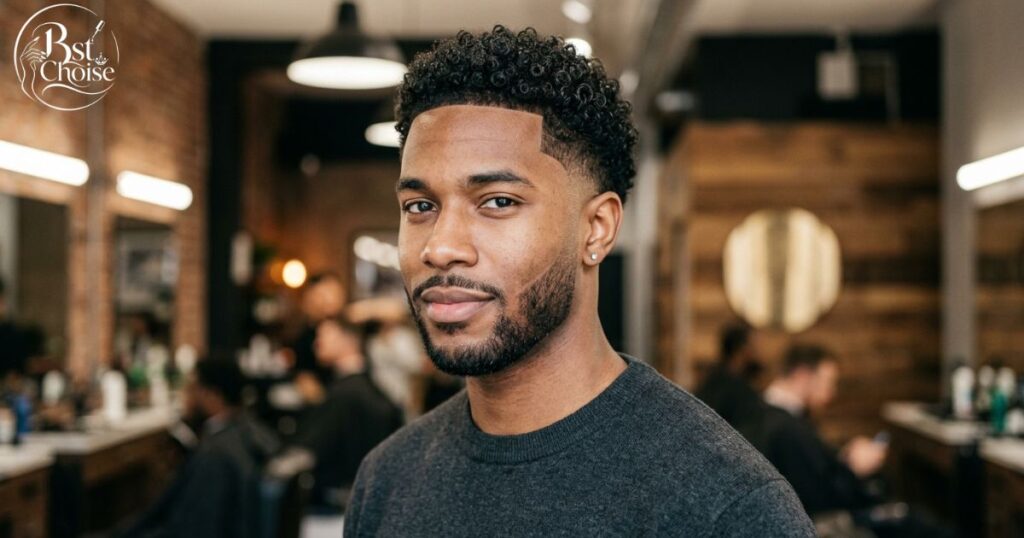
8. Curly Side Part With Low Taper
The top follows a natural side division rather than a shaved-in hard part, with the curls softening the line. The taper stays underneath, out of competition with the top.
Best for: Smart-casual and office settings.
Hair type: Loose to medium curls.
Face shapes: Oval, heart, diamond.
Maintenance: Every 3 weeks.
If your curls already grow with a clear direction, a natural part usually looks more intentional than a hard shaved line.
Pros: Dresses up easily, versatile between casual and formal, keeps texture intact.
Cons: Needs sufficient top length to hold the part; definition fades as curls grow out.

9. Curly High-Volume Top With Low Taper
This one leans into height and volume on top while keeping the taper deliberately restrained, giving a strong vertical line without a high fade.
Best for: Men who like a noticeable, voluminous top.
Hair type: Dense curls.
Face shapes: Round, oval, square.
Maintenance: Every 2–3 weeks.
Round faces often benefit from the added height, but there’s a ceiling, an oversized top can throw off proportion instead of balancing it.
Pros: Bold profile, turns natural density into an advantage, visually lengthens rounder faces.
Cons: Needs regular styling; can become unruly as it grows past the intended shape.
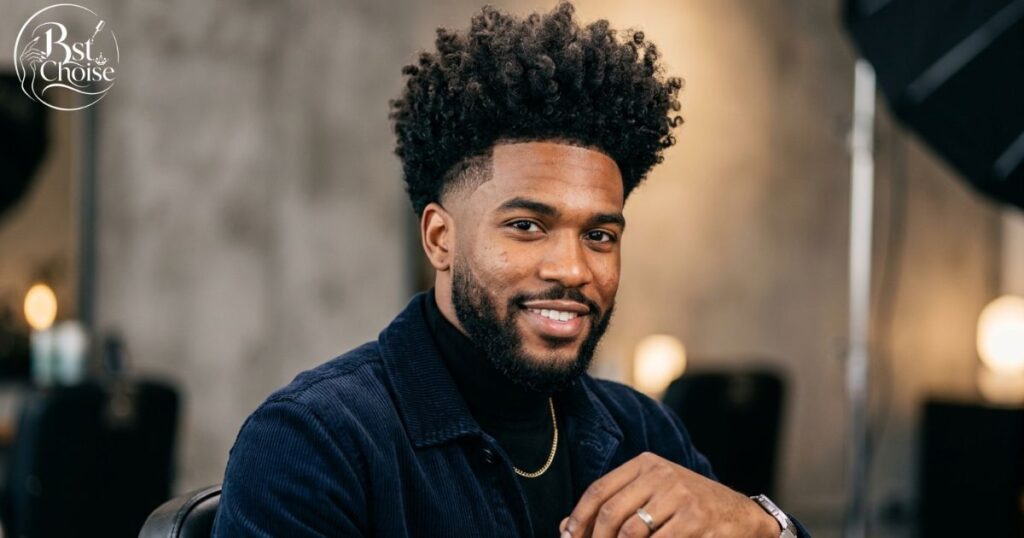
10. Curly Mohawk-Inspired Low Taper
Curl density is concentrated through the center of the head while the sides taper low, hinting at a mohawk shape without an aggressive skin fade.
Best for: Guys after something a little bolder.
Hair type: Dense curls and coils.
Face shapes: Oval, square, diamond.
Maintenance: Every 2 weeks.
This design needs enough central density to hold its shape, on finer or more widely spaced curls, it can read as thin rather than deliberate.
Pros: Distinctive silhouette, makes strong use of thick curl texture, more dramatic than a typical taper.
Cons: Less conservative for formal environments; needs careful, ongoing shaping.
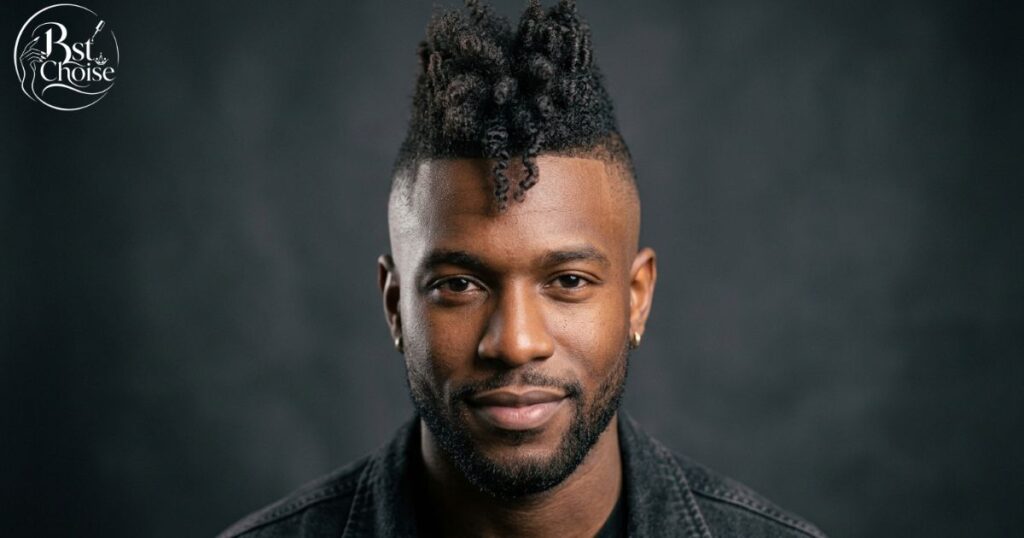
11. Curly Fringe With Natural Hairline
The front is left soft, following the hairline as it naturally grows instead of squaring it off with a sharp edge.
Best for: Men who want the haircut to look effortless.
Hair type: Loose, medium, or tight curls.
Face shapes: Oval, diamond, heart.
Maintenance: Every 2–3 weeks.
A natural hairline doesn’t need to be perfectly symmetrical, pushing the corners back just to create sharper lines often makes the cut look more artificial, not less.
Pros: Softer overall look, preserves the real hairline, grows out cleanly.
Cons: Less crisp definition; relies on a barber with a good eye for natural shaping.

12. Curly Taper With Sharp Lineup
This version plays natural curl texture against a razor-sharp front edge, creating strong contrast between “loose” on top and “precise” at the hairline.
Best for: Men who like a crisp, finished appearance.
Hair type: Dense curls and coils.
Face shapes: Square, oval, diamond.
Maintenance: Every 1–2 weeks.
The lineup should clean up the hairline you already have, not chase it further back every visit in search of a sharper corner.
Pros: Striking contrast, looks its best right after the cut, strong definition.
Cons: Edges grow out fast and get noticeable quickly; needs frequent upkeep.
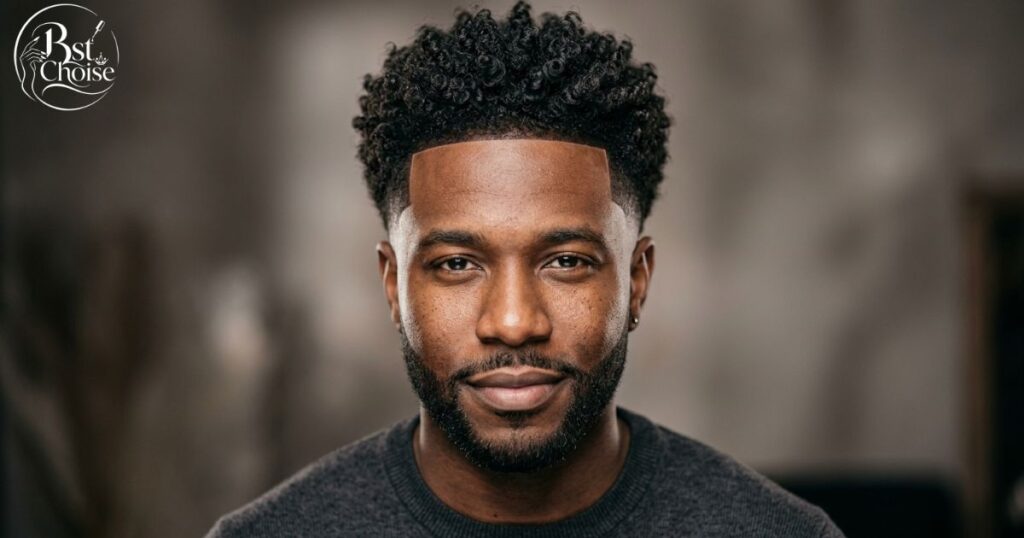
13. Curly Top With Temple Shadow
Instead of an obvious skin-out fade, the temple area is only lightly tapered, creating a soft, low-contrast transition into the curls.
Best for: Guys who don’t want a dramatic fade line.
Hair type: Fine to dense curls.
Face shapes: Oval, round, heart.
Maintenance: Every 2–3 weeks.
Because there’s no large bare patch beside the curls, this style tends to read as fuller overall, even at a similar length to other tapers.
Pros: Looks fuller, grows out gracefully, suits conservative workplaces.
Cons: Less bold; requires careful blending to avoid an uneven look.

14. Curly Top With Longer Neckline
The top stays curly and controlled, but the neckline is left with a bit more length and movement rather than a hard, shaved-in line.
Best for: Men after a softer, more modern silhouette.
Hair type: Loose curls and waves.
Face shapes: Oval, diamond, oblong.
Maintenance: Every 3–4 weeks.
That extra length at the back needs to be shaped intentionally, left completely alone, it can start looking overgrown rather than stylistically longer.
Pros: Distinctive look, good bridge style between short and long, flatters looser curl types.
Cons: More upkeep at the neckline; not ideal for strict formal dress codes.
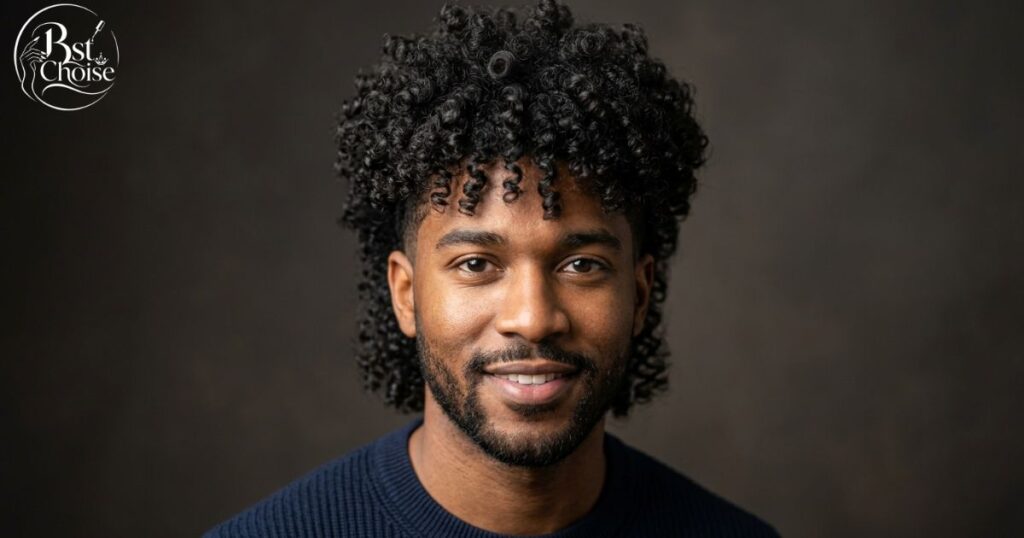
15. Curly Taper With Defined Crown
Extra attention goes into shaping the crown so the curls form a controlled point rather than an uneven, random peak.
Best for: Guys whose crown tends to grow unevenly or stick up.
Hair type: Dense curly hair.
Face shapes: Oval, square, round.
Maintenance: Every 2–3 weeks.
The crown shouldn’t be flattened for the sake of convenience, a skilled barber will work with its natural growth pattern rather than against it.
Pros: More balanced overall shape, tames a difficult growth pattern, keeps volume intentional.
Cons: Needs an experienced hand; can bulk up quickly between cuts.

16. Curly Two-Block-Inspired Taper
Noticeable weight is kept through the upper curls while the lower perimeter gets a genuine low taper, borrowing the two-block silhouette without fully disconnecting the sides.
Best for: Men after a more fashion-forward shape.
Hair type: Loose and medium curls.
Face shapes: Oval, diamond, heart.
Maintenance: Every 3 weeks.
The retained upper-side weight is what makes this style work. Fade too deep into the side and the whole two-block effect disappears.
Pros: Modern, editorial silhouette, keeps curl volume intact, stands out from a standard taper.
Cons: Needs careful proportioning; can look bulky if the top isn’t balanced correctly.
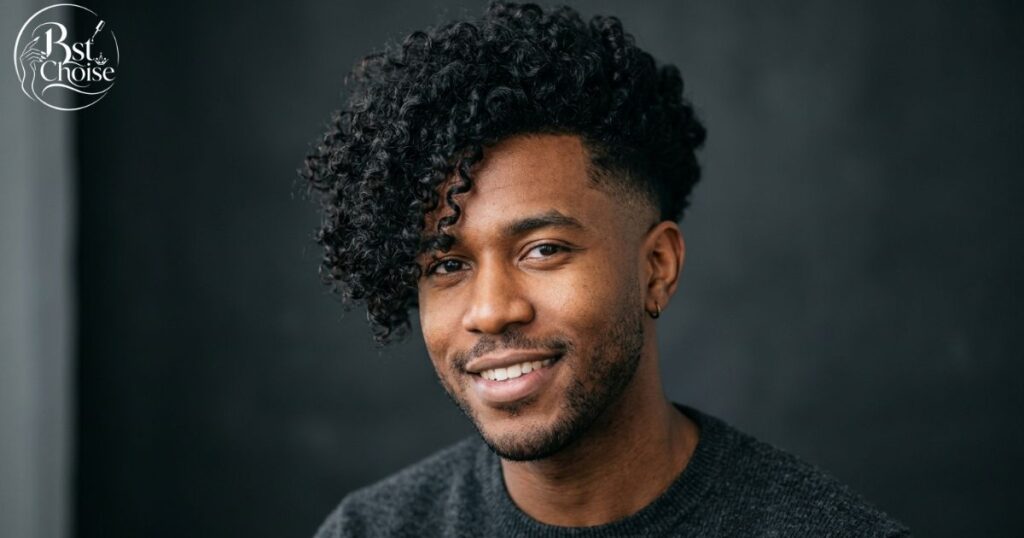
17. Curly Taper With Forward Crown
The curls move naturally toward the forehead, creating one continuous flow from crown to fringe instead of a defined part.
Best for: Guys who’d rather skip a hard part altogether.
Hair type: Medium curls, loose curls.
Face shapes: Oval, oblong, diamond.
Maintenance: Every 2–3 weeks.
Letting curls follow their natural growth direction almost always looks more consistent than forcing them backward with heavy product.
Pros: Natural movement, simple to style day to day, strong facial framing.
Cons: Direction is dictated by your growth pattern, not personal preference; can feel front-heavy.
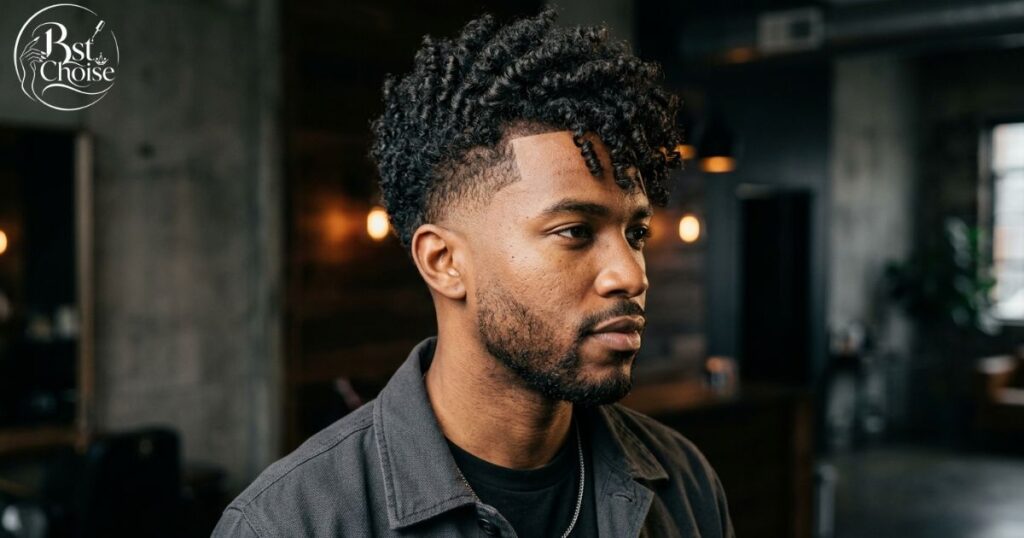
18. Curly Taper With Low-Contrast Neckline
The neckline is cleaned up without creating a stark line against the skin, giving the back of the haircut a softer finish.
Best for: Men who want a subtler overall look.
Hair type: Curly, wavy, medium-density.
Face shapes: Most face shapes.
Maintenance: Every 2–3 weeks.
A softer neckline tends to grow out far more gracefully than a razor-sharp one, especially when the curl continues down toward the neck naturally.
Pros: Grows out cleanly, understated finish, low-maintenance edges.
Cons: Lacks crisp definition if you prefer very sharp lines.

19. Curly Taper With Controlled Volume
The curls stay full and voluminous but are shaped so the top doesn’t spread too wide, with the taper providing structure underneath.
Best for: Men with very dense, thick curls.
Hair type: Dense, coarse curls.
Face shapes: Round, oval, square.
Maintenance: Every 2–3 weeks.
Some internal thinning can help manage bulk, but overdoing it disrupts how the curls naturally cluster, the goal is control, not maximum reduction.
Pros: Makes dense hair manageable, keeps fullness intact, strong overall shape.
Cons: Requires an experienced barber with texturizing shears; can feel heavy between cuts.
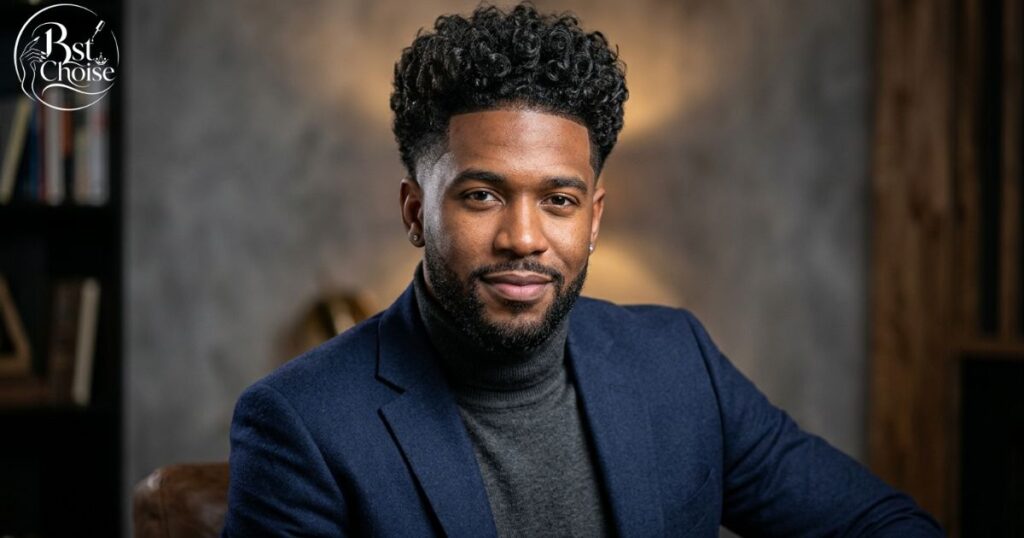
20. The Personalized Curly Low Taper
The final entry isn’t a specific look, it’s a philosophy. Instead of copying a trend, the barber builds the cut around your curl pattern, head shape, hairline, and preferred length.
Best for: Anyone who wants a cut built for their hair, not a reference photo.
Hair type: Any curl pattern.
Face shapes: Any, with proportion adjustments.
Maintenance: Usually every 2–3 weeks.
This is often the most reliable route with curly hair. A photo can communicate a general idea, but curl density, diameter, and growth direction ultimately decide how that idea should be executed on your head.
Pros: Fully adaptable, works with your actual texture, tends to grow out more naturally.
Cons: Needs a skilled, curl-experienced barber; harder to guarantee an exact match to a reference image.
The Biggest Mistake: Cutting Curly Hair Like Straight Hair
The single most common error with curly haircuts is treating stretched, wet length as the final result.
Curls contract once they dry, sometimes dramatically, and density isn’t even across the head. The crown might coil tighter than the front, and the temples can grow in an entirely different direction than the rest of the scalp.
A haircut that actually works with curls has to account for:
- Shrinkage after drying
- Overall density
- Curl diameter and pattern
- Natural growth direction
- Hairline shape
- Crown behavior
- How much volume you actually want on top
Quick check: If your curls look noticeably shorter once washed than they did right after the cut, that’s usually shrinkage, not a bad haircut. It should be factored in before the clippers come out, not blamed afterward.
Where the Taper Should Stay Low
A genuinely low taper focuses on the temple, sideburn, and neckline, nowhere else.
The upper sides should keep enough hair to connect naturally into the curly top. Once the blend starts climbing toward the parietal ridge (the widest part of the skull, roughly in line with the top of your ears), you’ve moved into a higher fade, whether that was the intention or not.
This distinction matters more with curly hair than straight hair because curls carry visual weight. Strip too much away at the sides and the top can suddenly look oversized in comparison.
Barber note: If you want a true low taper, be specific: ask your barber not to “chase the blend upward” and to preserve the weight along the upper sides. That one line prevents most disconnected results.
Should Curly Hair Get a Lineup?
There’s no universal right answer here, it comes down to the look you’re after.
- A natural hairline keeps the cut softer and usually grows out with far less maintenance.
- A sharp lineup creates stronger contrast against the curl pattern and gives the front a more deliberate, finished look.
What matters is not pushing the hairline further back purely to chase perfectly straight corners. Your natural hairline sets the limit for how much can be cleaned up without sacrificing density.
Reality check: A crisp lineup looks sharp in a reference photo, but your actual hairline, not the photo, determines what’s realistically achievable.
Curly Hair and Face Shape For Men
Rather than hunting for a haircut “approved” for your face shape, think about where volume should sit to balance your features.
Round Face
Add height through the crown to create a longer visual line, and avoid excess width at the sides, which can make the face look wider than it is.
Square Face
Curls naturally emphasize a strong jawline. A softer fringe or slightly rounded top can take the edge off an angular structure if that’s the goal.
Oblong Face
Keep height minimal. Forward-falling curls or a fuller fringe help widen the face visually and balance out extra length.
Oval Face
The most flexible face shape for curly cuts, nearly every fringe, crown height, and volume level on this list will work.
Diamond Face
Retaining some width through the upper sides helps balance a narrower forehead and jawline.
How to Style a Curly Low Taper
Curly hair generally looks best with less manipulation once the curl pattern has formed, the goal is to enhance it, not reshape it every morning.
- Apply a lightweight curl cream or leave-in product to damp hair, distributing it evenly through the curls rather than focusing on a few strands.
- For tighter curls or coils, use a diffuser attachment to control the drying process without flattening the pattern.
- For looser curls or waves, a small amount of matte cream is often enough to hold shape without weighing hair down.
- Avoid brushing dry curls unless you specifically want a fuller, looser texture, brushing breaks up curl clumps and creates frizz.
Styling check: If your curls already have good definition, more product isn’t automatically better. Overdoing it can turn separated curls into one heavy, clumped mass.
What to Tell Your Barber
Don’t just hand over a photo and say “like this.” Curly hair varies too much from person to person for that alone to work. Instead, describe what actually matters:
“Keep the taper low around the temples and neckline, preserve the curl density above the ears, and cut the top based on how my curls fall when they’re dry.”
Then be specific about:
- Natural or sharp hairline
- Desired fringe length
- How much crown volume you want
- Temple height
- Neckline finish (hard line vs. soft blend)
- Whether the taper should connect into a beard
- Compact vs. fuller curl shape
If your curls shrink a lot after washing, mention that upfront, it changes how much length the barber should leave.
Curly Taper Maintenance
A low taper on curly hair tends to lose its sharpness well before the top itself starts looking unkempt. Here’s roughly what to expect between appointments:
| Timeframe | What Happens |
| Week 1 | Taper stays crisp; curls hold the shape from the cut. |
| Week 2 | Temple and neckline regrowth starts becoming visible. |
| Week 3 | Taper loses definition, though the top can still look good. |
| Week 4 | The cut softens noticeably, especially around the ears and neckline. |
If you like a natural, slightly grown-out finish, stretching the taper longer works fine. If you prefer a consistently crisp perimeter, book touch-ups every 2–3 weeks.
Mistakes to Avoid
Taking the taper too high
This strips away the support the sides give the curly top, and can make dense curls look disconnected almost overnight.
Cutting based on wet length
Curly hair contracts as it dries. A cut measured on wet strands almost always looks shorter than expected once it’s air-dried.
Over-thinning the curls
Heavy thinning shears can break up how curls naturally cluster, leaving patchy or uneven texture instead of clean definition.
Ignoring the crown
A crown that grows against the rest of the pattern can throw off the whole silhouette if it isn’t shaped intentionally.
Forcing a straight hairline
Squaring off a naturally uneven hairline usually looks less convincing than working with the shape you already have.
Using too much product
Excess product weighs curls down, clumps them together, and can leave hair looking greasy instead of defined.
Copying someone else’s curl pattern
The exact same haircut on two different curl densities and diameters will not produce the same result, use references as inspiration, not a blueprint.
Frequently Asked Questions
Is a low taper good for curly hair?
Yes, it gives the perimeter clean structure while leaving the curl density and texture on top untouched, which is exactly what curly hair needs.
Should curly hair be cut wet or dry?
Ideally both are considered, but the final shape should always be judged dry, since that’s how curls actually sit day to day.
Does a low taper make curls look better?
It can, by creating cleaner contrast at the temples and neckline, the effect largely depends on how much upper-side weight the barber keeps.
Can I get a low taper with tight curls?
Yes. Tight curls and coils actually hold a compact, defined shape very well against a clean, low-tapered perimeter.
Can I combine curls with a beard?
Definitely. A well-blended sideburn connecting the taper into the beard creates a stronger, more cohesive overall look.
Should I get a lineup with curly hair?
It’s optional, a lineup adds sharper contrast, while a natural hairline gives a softer look with easier grow-out.
How often should I maintain a curly low taper?
Every 2–3 weeks keeps the perimeter clean; you can stretch it longer if you prefer a softer, more relaxed finish.
What product is best for a curly taper?
A lightweight curl cream, leave-in conditioner, or curl-defining product works best, the right pick depends on your curl density and desired hold.
Can a low taper work with long curly hair?
Yes. Because the taper stays low, plenty of length and movement can remain through the crown, top, and back.
Conclusion
A curly low taper works best when the fade supports the curls instead of competing with them. The real decisions happen around the temples, neckline, crown, and hairline, but the top should always follow your actual curl pattern, not a trend name.
Tight coils often suit a compact shape, loose curls can carry extra length, and dense curls usually respond better to controlled volume than aggressive thinning. Bring a reference photo if it helps, but pair it with a clear explanation of how your curls behave once they’re dry, and be specific about how much side weight you want to keep.
The best curly low taper isn’t the one with the most dramatic fade line, it’s the one where the perimeter looks clean and the curls on top still look like they belong there.

