
A long face does not limit your haircut options. It simply changes which bob will look best on you. The right length, a little fringe and some volume at the sides can make your face look softer and more balanced.
This guide covers the best chubby face long bob haircuts, why they work, how to style them, and how to talk to your stylist. You will also find upkeep schedules, seasonal tweaks and the mistakes that trip most people up.
Key Takeaways
- A chin-length to jaw-length bob adds width and breaks up vertical length.
- Bangs, curtain fringe or side-swept fringe shorten a high forehead.
- Volume belongs at the sides, not at the crown.
- Waves, curls and layers add the horizontal fullness a long face needs.
- Skip long, straight, one-length hair that drags the face downward.
- Plan a trim every 5 to 6 weeks to keep the shape sharp.
Stop Second-Guessing Your Face Shape Now: The Bob Selection Guide
A long face, also called an oblong or rectangle face, is noticeably longer than it is wide. Many people also have a taller forehead, straight cheek lines and a longer chin.
None of that is a problem. It just means your haircut should do two jobs: add width and reduce the look of length.
Quick face shape check (about two minutes):
- Pull your hair back and stand in front of a mirror.
- Compare your face length (hairline to chin) with your cheekbone width.
- If your face is clearly longer than it is wide, and your forehead, cheeks and jaw are close in width, you likely have a long or oblong face.
Face shape is a guide, not a rule. Your hair texture, density and lifestyle matter just as much.
Will a Bob Make My Long Face Look Even Longer?
No. A bob that ends at the chin or jaw usually makes a long face look more balanced, because it adds width where the face is narrowest. The cut to be careful with is a very long, straight bob that falls well past the collarbone.
The Science Behind Why Certain Bobs Work Magic on Long Faces

It comes down to simple visual balance. Your eyes follow lines, and hair creates lines around your face.
Vertical lines make a face look longer. Horizontal lines and sideways volume make it look shorter and wider. A well-cut bob uses the second effect.
Here is what stylists use to get there:
- A horizontal cutting line. The straight edge of a bob acts like a visual “stop” at the jaw, so the eye does not keep travelling down.
- Width at cheek and jaw level. Waves, layers or a slight flip add fullness exactly where a long face needs it.
- Fringe to shorten the forehead. Bangs cover part of a tall forehead, which cuts the apparent length of the face.
- A flexible part. A deep side part breaks up symmetry and adds width. A sharp center part can emphasize length.
- Low crown volume. Height on top adds length, so keep lift gentle.
| Works well | Usually works against you |
| Chin to jaw-length bob | Very long, one-length hair |
| Curtain, side-swept or full bangs | Slicked-back styles with a bare forehead |
| Waves and curls with sideways volume | Tall volume or high crown teasing |
| Soft layers around the cheeks | Thin, wispy ends with no body |
| Deep side part | Razor-straight center part |
A note on length. Stylists do not agree on one perfect length. Many recommend a bob that ends at the chin or jaw. Others prefer a long bob (lob) with bangs, because a hard line at the chin can look stark on some faces. A good rule: stay above the collarbone, add fringe or layers, and adjust after you see how your hair behaves.
Read More: 25 Bro Flow Haircuts For Men That Look Naturally Stylish
Your Complete Bob Styling Arsenal
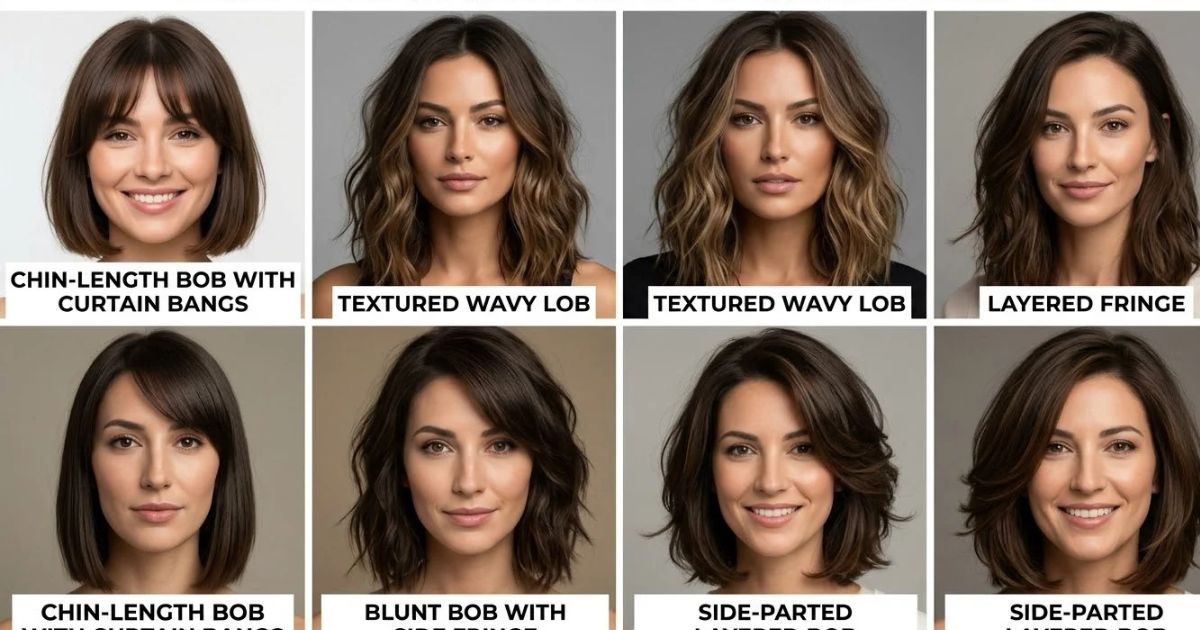
These are the most flattering bob haircuts for long faces, with the details that make each one work.
| Bob type | Length | Why it suits a long face | Styling time | Best for |
| Blunt bob with fringe | Chin to jaw | Strong horizontal line plus a shortened forehead | 8 to 10 min | Straight or fine hair |
| Textured bob | Jaw | Choppy ends add movement and width | 5 to 7 min | Medium to thick hair |
| Wavy lob with curtain bangs | Above or at collarbone | Soft waves build sideways volume | 5 to 8 min | Wavy or fine hair |
| Asymmetrical bob | Chin, longer in front | Angles break up vertical lines | 10 to 12 min | Straight or wavy hair |
| Curly bob | Chin to jaw | Natural curl adds width all around | 8 to 10 min | Curly or coily hair |
Face-framing choices that help:
- Curtain bangs: A softer first step if full bangs feel like a big commitment.
- Side-swept bangs: Easy to grow out and good for a taller forehead.
- Blunt or full bangs: The boldest face-shortening option.
- Cheekbone-level layers: Add shape without removing weight from the ends.
How to Style a Bob Haircut: My Foolproof 5-Minute Method
This routine works on most bobs and keeps volume at the sides instead of the top.
- Start with damp hair. Towel-dry until it stops dripping.
- Apply a light styling cream. Work it from mid-lengths to ends, and keep it off the roots.
- Add heat protection. Use a spray if you will blow-dry or use a hot tool.
- Blow-dry with a round brush. Lift slightly at the roots, then curve the ends under or out for width.
- Shape the fringe first. Dry bangs while they are still damp so they sit flat and smooth.
- Add movement. Scrunch with your hands for texture, or bend the ends with a flat iron.
- Finish with a flexible-hold spray. Aim for movement, not stiffness.
Tool list: paddle or round brush, blow dryer with a concentrator nozzle, diffuser for waves and curls, and a flat iron or small curling iron.
Beyond the Basic Bob: Advanced Techniques That Make the Difference
Once the shape is right, a few details take a bob from good to polished.
The Power of Strategic Highlights
Color can add width without changing the cut. Lighter pieces around the face draw the eye outward. Balayage or soft babylights around the cheekbones create dimension and make the hair look fuller.
Keep the roots slightly deeper than the ends. That keeps the focus at the sides rather than pulling the eye upward.
Textural Elements That Count
Texture changes how the bob sits on your face. Ask your stylist about three things:
- Length variation: Slightly shorter pieces around the cheeks add soft volume.
- Angle variation: A slight slant or A-line shape adds interest and breaks symmetry.
- Surface texture: Point-cutting, waves or a light flip give the ends body.
Avoid ends that are too thin and wispy. On a long face, they tend to disappear and take the width with them.
The Maintenance Reality Check
A bob is a precision haircut. The shape is what makes it flattering, so it needs regular care.
| Bob style | Trim every | Daily styling | Product needs |
| Blunt bob | 4 to 6 weeks | 8 to 10 min | Smoothing serum, light spray |
| Textured bob | 6 to 8 weeks | 5 to 7 min | Sea salt spray, texture paste |
| Wavy lob | 8 to 10 weeks | 5 to 8 min | Mousse, light oil |
| Curly bob | 8 to 10 weeks | 8 to 10 min | Curl cream, leave-in conditioner |
Trim Schedule That Works
Book a trim every 5 to 6 weeks for a blunt or sharp bob. Softer, textured styles can go 8 weeks or a little longer. Waiting too long lets the length drift past the jaw, and that is exactly when a bob stops balancing a long face.
Tip: book your next visit before you leave the salon.
Daily Styling That’s Actually Doable
Pick a cut that matches how you already get ready. If you have five minutes, choose a wavy or textured bob that you can air-dry or scrunch. If you enjoy blow-drying, a sleek blunt bob will reward the effort.
Be honest in your consultation. A cut you cannot style yourself will not look good for long.
Product Investment vs. Daily Struggle
A few good products save more time than any gadget. You need only three basics:
- A lightweight blow-dry or styling cream
- A texturizing or sea salt spray
- A flexible finishing spray or shine serum
Buy for your hair type, not for the trend. Heavy products flatten fine hair, and light ones leave thick or curly hair frizzy.
Seasonal Styling Switches
How Do You Switch Up Your Bob Hairstyle for Different Seasons?
Keep the same cut and change the finish: textured and loose in humid months, smooth and polished in dry, cold ones. Adjust products, color tone and accessories to match.
Winter is your sleek season.
Lower humidity makes smooth hair easier to hold. Use a smoothing serum and a paddle brush for a glossy blowout. Add an anti-static spray, and a little leave-in conditioner to fight dry indoor air.
Summer Styling
Heat and humidity are hard to fight, so work with them. Use sea salt spray and air-dry or diffuse for relaxed waves. Choose lightweight products, rinse out sweat and chlorine, and use a UV or heat protectant when you can. Brighter face-framing highlights suit this season well.
Winter Sophistication
Cold months suit richer color and more formal styling. Deeper tones such as chocolate, espresso or soft copper look elegant with knitwear and coats. Wear a sleek side part for work and a low tuck-behind-the-ear look for evenings. Use a silk or satin hat liner so hats do not flatten your sides.
Common Bob Mistakes to Avoid
| Mistake | Why it backfires | Better move |
| Going too short too fast | Hard to undo and may leave too much forehead showing | Start at the jaw or chin, then go shorter |
| Ignoring hair type | Fine, thick and curly hair behave differently | Ask for a cut built for your texture |
| Choosing style over lifestyle | High-effort cuts get abandoned | Match the cut to your real routine |
Going Too Short Too Fast
If you have never had a bob, start at the chin or just below. You can always cut more at your next visit. Hair takes months to grow back.
Ignoring Your Hair Type
Fine hair needs blunt lines to look fuller. Thick hair needs internal layers or thinning to avoid a heavy shape. Curly hair needs to be cut dry or while curled, and it shrinks, so length should be planned with that in mind.
Choosing Style Over Lifestyle
A cut from social media may need daily heat styling you do not have time for. Think about gym days, humidity, hats, glasses and how often you can come in for trims.
The Consultation Conversation
A good consultation saves you from a haircut you will regret. Bring these things:
- Two or three photos of bobs you like, plus one you do not.
- Your daily routine: how long you really spend styling.
- Your habits: how often you wear it up, and how often you can trim.
- Your concerns: high forehead, thin ends, cowlicks or frizz.
Say this to your stylist:
“I have a long face. I want a bob that adds width at the sides and shortens my forehead. Can we try chin or jaw length with soft layers and bangs?”
Then ask three questions:
- Where exactly will this hit on my face?
- How will it change as it grows out?
- What products and tools do I need at home?
Quick FAQs About Bob Hairstyles for Long Faces
What is the best bob length for a long face?
Chin-length to jaw-length bobs are the safest choice. A lob that stops above the collarbone also works, especially with bangs.
Should I get bangs with a bob if I have a long face?
Yes, in most cases. Bangs shorten a tall forehead and make the whole face look more balanced.
Which bob should a long face avoid?
Avoid very long, straight, one-length bobs with no layers, and any bob with tall crown volume.
Is a lob better than a short bob for a long face?
Both can work. A short bob adds more width at the jaw, while a lob with bangs feels softer and needs less upkeep.
Final Thoughts
The best bob hairstyles for long faces share a few traits: a length that stops at the jaw or just below, soft volume at the sides and some fringe to shorten the forehead. From there, choose the version that suits your hair type and daily routine.
Bring photos, be honest about your styling time and ask your stylist how the cut will grow out. A bob that fits your face and your life will look better and feel easier to wear than any trend.
Ready to try it? Book a consultation and show your stylist this guide.

